

EU leaders will have their hands full as they wrangle over the next budget and future support for Ukraine. Both issues make for a potentially unpredictable mix.
Two of the EU's most contentious issues are set to collide at a turbulent summit in Brussels: the bloc's next long-term budget and continued support for Ukraine.
 ADVERTISEMENT
The talks on Thursday, which might stretch into Friday, aim to pave the way for a final deal at a pivotal meeting in December.
On the one hand, the 27 leaders will spar over the bloc's new long-term budget, which will determine the level of spending for critical areas like farming subsidies, infrastructure, border control and green energy for the next seven years.
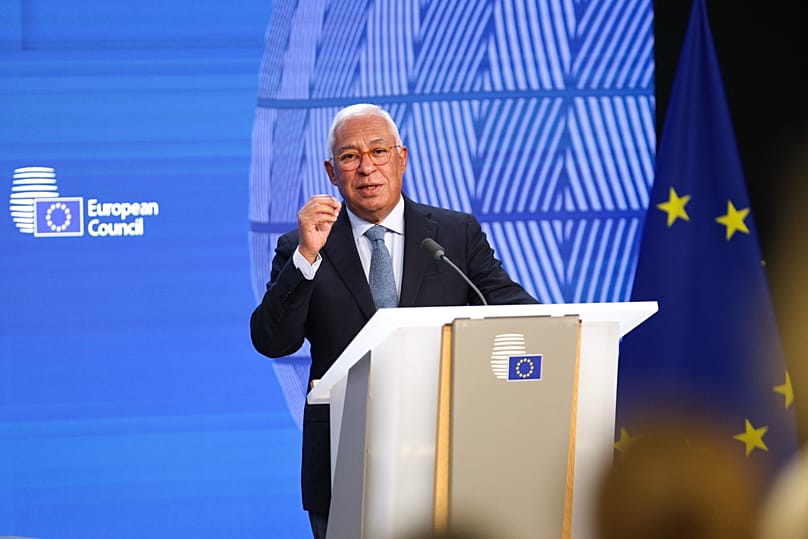
António Costa, the president of the European Council, has offered a compromise that cuts the original proposal by €204 billion.
"The time has come to reach an agreement," Costa told leaders ahead of the summit.
On the other hand, they will scramble to plug Ukraine's soaring deficit and maintain a steady flow of financial and military assistance as Russia's brutal war rages on.
The European Commission has tabled a €45 billion support loan backed by joint debt to keep the country's economy afloat and its armed forces in the fight.
On paper, the two issues are separate. Politically, however, they are increasingly intertwined, creating a combustible mix that could descend into a bitter dispute.
"You can't avoid the discussions being mixed up," a diplomat said.
Stuck on red lines
The battle lines are starkly drawn.
The so-called "frugals" – Austria, Belgium, Denmark, Finland, the Netherlands, Sweden and Germany – are displeased with Costa's compromise and demand deeper cuts to traditional envelopes, namely agriculture and cohesion, to channel more cash into modern-day priorities such as defence, climate and technology. (Hence why they have rebranded themselves as "modernisers".)
This has met with pushback from the 17 "Friends of Cohesion", a group encompassing Southern and Eastern European countries, who want to preserve high expenditure on both traditional and modern priorities. This camp is unhappy with Costa's proposal because, they say, it cuts excessively across the board.
"I think it would have been more useful to put forward a relatively good proposal rather than playing out a bazaar scene reminiscent of Cairo, Tunis, or Marrakesh," Hungarian Prime Minister Péter Magyar said ahead of the summit.
France has adopted a hardline stance, slamming Costa's compromise as "highly disappointing", despite including the digital services tax that Paris has long advocated.
France, mired in a financial crunch at home, is keen to boost EU-wide taxes to maintain spending without increasing its national contribution.
The chasm between the competing sides has proven irreconcilable and left member states stuck on their red lines. Diplomats admit that discussions over the past few months have gone round in circles, with little meaningful progress to show for them.
The impasse puts Costa, the moderator-in-chief, in the hot seat to deliver a unanimous deal by the end of the year. The Council president intends to steer the two-day summit through bilateral and multilateral meetings to coax leaders face-to-face.
The budget is widely seen as a defining test of Costa’s presidency, with the outcome potentially weighing heavily on whether he secures a second 2.5-year term.
If negotiations spill over into 2027, they will become dangerously entangled with the French presidential election. Marine Le Pen, the frontrunner, has vowed to upend the deal and cap France's contribution at €5 billion per year.
Paris has upped the ante to avoid such a scenario.
"Several other member states will also be holding elections, beyond the French presidential election, throughout the first and even the second half of 2027," the Élysée said. "Therefore, our position has been, and remains, very clear: the negotiations cannot go beyond December."
A divisive ultimatum
Ukraine further muddles the equation.
Russia's non-stop attacks, deliberately aimed at devastating the Ukrainian economy, have drilled a €70 billion hole in Kyiv's 2027 budget.
The Commission's €45 billion loan is meant to cover two-thirds of this gap. Other allies, such as the UK, Norway, Canada and Japan, are expected to cover the remaining third.
Four member states – Slovakia, the Czech Republic, Hungary and Bulgaria – have already said they do not want to participate in this new loan, which will come on top of the ongoing €90 billion credit line and add to annual interest payments.
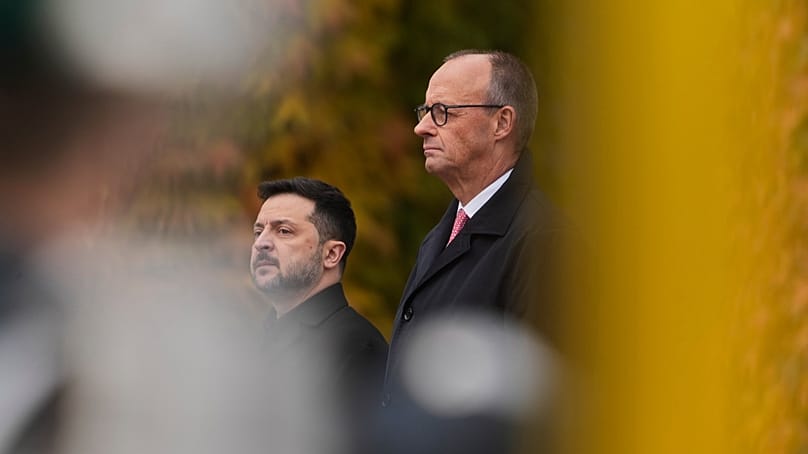
Their request has enraged German Chancellor Friedrich Merz, who has threatened to veto the budget if support for Ukraine is not agreed by all 27 member states. Slovak Prime Minister Robert Fico has denounced this as a "textbook case of blackmail".
Brussels is split on whether Merz's ultimatum will succeed or backfire.
Some believe his forceful attempt to link the two files is well-founded because Russia's aggression poses a threat to the bloc as a whole.
"Security is a public good. Security is, by definition, indivisible," another senior diplomat said. "It's very difficult to understand that four countries that are getting so much cohesion funding from the EU are being so egoistic not to support the common good of security. That doesn't make sense (and) is unacceptable."
Others, however, say it is a risky manoeuvre that could alienate leaders and exacerbate mistrust. The "Friends of Cohesion" believe the optics of a deal that cuts funding for poorer regions but boosts it for Ukraine would send a politically damaging message.
The Commission has offered a way out of the showdown by allowing countries to opt in to the loan's budget strand (€20 billion) and out of its military strand (€25 billion).
Costa wants leaders to look beyond 2027 and start a serious debate on how to finance Ukraine in the longer term, whether it is a longer war or a costly recovery.
The conversation will unfold against a backdrop of a sourer, darker mood. A new poll has found 53% of Germans oppose continuing military aid for Kyiv.
Thursday's summit comes amid intense efforts to bring the peace negotiations into a multilateral format with Ukrainian, European, US and Russian officials at the same table. The Kremlin has refused to commit and instead invited the European delegation to Moscow to discuss their possible participation in the next round of talks.
Brussels thinks Russia is not yet serious about peace and has already proposed fresh economic sanctions.