












Climate activists and members of the press are facing unprecedented barriers to one of the most important environmental conferences of the year.
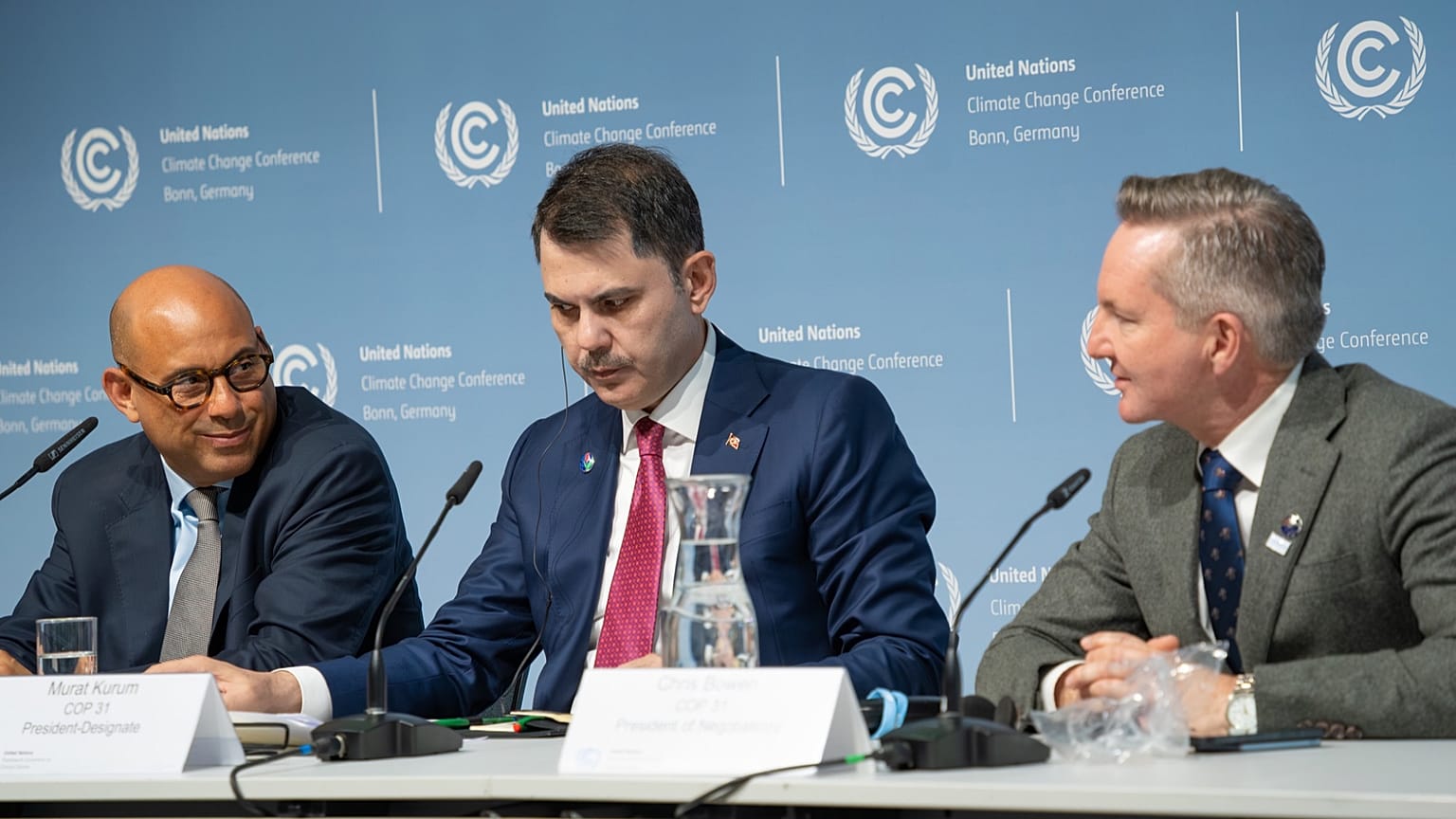
All eyes are on the German city of Bonn this week, as delegates from around the world gather for one of the biggest environmental conferences of the year.
 ADVERTISEMENT
ADVERTISEMENT
ADVERTISEMENT
The 64th session of the Subsidiary Bodies (SB64) of the United Nations Framework Convention on Climate Change (UNFCCC) is the first major negotiating session since COP30 in Belém, where almost 200 nations failed to produce a roadmap to phase out fossil fuels despite growing momentum.
The talks, which commenced on 8 June and will finish on 18 June, arrive at a moment of growing pressure to turn political commitments into implementation pathways on adaptation, fossil fuels, food systems, land use, trade, and just transition.
One of the main questions hanging over the summit will be how political initiatives can form outside of the formal UN process – following on from the success of the Santa Marta conference on fossil fuels that took place in April.
However, concern is growing that these climate talks are becoming increasingly inaccessible – particularly for those living in developing countries, who are the most affected by climate change.
‘A vital window’ into climate negotiations
“Climate negotiations affect billions of people around the world, but most people cannot be in the room,” Mohamed Adow, founder and director of climate think tank Power Shift Africa, tells Euronews Earth.
“Civil society press briefings are one of the key ways the public gets an independent account of what is happening behind closed doors. This issue is especially important because many journalists, particularly from developing countries, are unable to attend in person due to cost, visa barriers or shrinking newsroom budgets.”
For the last three decades, Climate Action Network (CAN), a global network of more than 2,500 civil society organisations in over 150 countries, has held daily press briefings at UN climate talks.
These briefings are the main way that those organisations can communicate what is happening inside the negotiations to journalists, observers and the wider public.
However, this year at Bonn, CAN International was allocated just five press conference slots for the entire conference. On LinkedIn, Adow described the move as a “deliberate narrowing of civic space”.
After Adow’s post gained traction online, the UN has now allocated CAN International two additional press conference slots during the SB64 summit. The organisation has a further five slots allocated to its regional representatives.
“Civil society briefings are one of the few ways the public can understand what is happening inside highly technical negotiations," Dr Ketakandriana "Ke" Rafitoson, Executive Director of Resource Justice Network, tells Euronews Earth.
If the UN climate process is serious about a just transition, Dr Rafitoson argues that it must protect the civic space that allows impacted communities and their representatives to be heard.
But the perceived shrinking of civic space may have a different explanation: the number of NGOs admitted to COPs grown sharply over the years, from just 1,376 at COP16 in 2010, to 2,872 at COP26 in 2020, to 3,907 at last year's COP30.
While CAN represents a number of these, the growing attendance list leaves finite press briefing slots spread out across a larger number of organisations.
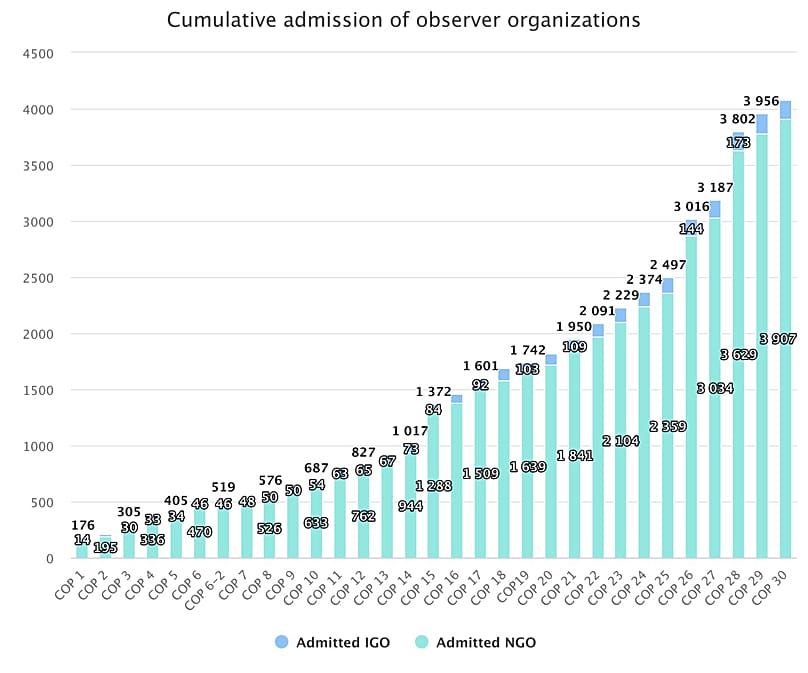
"The strong growth in civic participation means some modest adjustments to ensure the voices from smaller organisations – particularly from the Global South – also have a fair chance to be heard," a UN Climate Change spokesperson tells Euronews Earth.
"We welcome ongoing dialogue on these issues, and our teams work hard to make press conference facilities – live-streamed to the global public – fully operational and available to all Parties at COPs, as well as to Environmental NGOs – along with the eight other constituency groups these press conference facilities need to accommodate, including Indigenous Peoples, the Women and Gender Constituency, farming and agriculture, business and industry, local government, research and independent NGOs, youth, and trade unions."
Oil and gas lobbyists dominate COP delegations
Meanwhile, the number of pro-oil lobbyists attending these kinds of events is also growing. A 2025 analysis by the Kick Big Polluters Out (KBPO) coalition found that one in every 25 COP30 attendees was a fossil fuel lobbyist a 12 per cent increase compared to the 2024 talks in Baku, Azerbaijan.
According to KBPO, this marks the largest concentration of fossil fuel lobbyists – defined by them as organisations that fund or benefit from obstructing climate action – at COP since the coalition started tracking attendees in 2021.
As secretariat of COP, UNFCCC does not control who governments choose to bring as delegates, but it has taken steps to improve transparency in recent years.
This includes making spreadsheets of official participants publicly available. Party overflow – extra individuals registered under a country's official government delegation who are not part of the primary negotiating team, such as civic society and lobbyists – has also been included in recent years.
Building on this, delegations must now also state their relationship with nominees and identify the home organisation of nominated individuals.
Voluntary measures introduced in 2025 include encouraging non-Party stakeholders to disclose the funding sources of their participation. They are also invited to declare whether their participation aligns with the principles of the foundation and the Paris Agreement – choosing not to answer this could be telling.
Bonn’s big visa problem
Many governments argue that negotiations require a controlled space in order to be effective, but Baboucarr Nyang of CAN Africa tells Euronews Earth that there is a “profound difference between a quiet room and a closed one”.
“Negotiations can be focused and still be fair,” he adds. “But when it is consistently African delegates, Pacific islanders, and frontline community representatives who are denied visas, delayed at borders, or priced out by soaring hotel costs while wealthy country delegations arrive without a single barrier – that is not process management. That is exclusion wearing a bureaucratic mask.
Visa barriers to climate meetings are neither new or unique to Bonn. The German Institute of Development and Sustainability (IDOS) has been raising concerns about exclusion of delegates from the least developed countries from UN climate negotiations in Europe due to paperwork delays as far back as 2008.
Last year’s climate event in Bonn saw 223 delegates from Africa and Asia experience difficulties in getting visas in time or at all. 25 applicants were denied a visa outright, while 167 applications were left unprocessed and 37 received visa delays.
Burundi, Cameroon, Egypt, Morocco, and Rwanda were all left without a single representative due to this issue, and things are only getting worse. According to the IDOS, reported cases of delegates struggling with their visa application rose to 298.
While participants should, in theory, be granted visas based on their accreditation, it comes down to the host country to issue them on time.
The German Foreign Office did not immediately respond when asked about visa processing delays.
Meet the climate activists excluded from UN climate talks
Randa Khaled from the Egyptian environmental organisation Greenish is just one of the many climate activists who will likely miss the negotiations due to her visa application not being processed in time.
Khaled obtained UNFCCC accreditation, applied for a visa – paying €150 – made travel preparations and submitted her visa application on time, but her participation remains uncertain.
She tells Euronews Earth she’s "devastated" by the visa backlog, adding: “What makes this especially frustrating is that climate negotiations repeatedly emphasise inclusion, equity, and participation.
“However, when representatives from countries like Egypt are unable to physically access the spaces where decisions are being made, those principles begin to feel conditional rather than universal.”
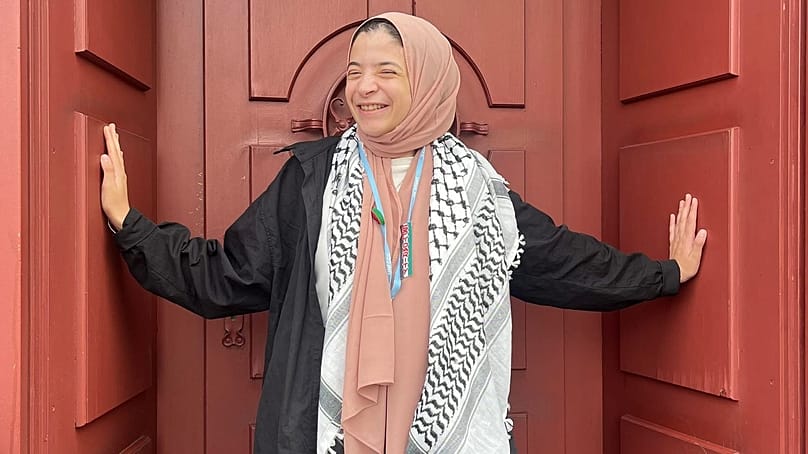
The financial impact has also been “significant” for Khaled: “For many grassroots organisations and youth-led initiatives, resources are already limited. Every delayed visa, every postponed appointment, and every uncertainty carries a real financial cost that wealthier organisations from developed countries are often better positioned to absorb.”
Khaled argues that the ongoing issue contradicts the heart of global climate governance, demanding that mobility and access must be treated as part of climate justice itself.
Euronews Earth has been told that an employee from Powershift Africa, who lives in Ghana, has had her German visa rejected.
“Imagine spending months preparing to represent your community at the most important climate meeting in the world only to be turned away at the embassy or not even being responded to,” Nyang says.
“This is the reality for too many African delegates. When the people who live with floods, droughts and food insecurity every single day cannot get into the room, how can anyone call the outcomes fair?
“Trust is not built in polished communities. It is built when a Ugandan farmer, a Kenyan fisherwoman, or a Sahelian pastoralist can see someone who looks like them, who has walked in their shoes, sitting at that table.”
This article has been edited to reflect the growing number of NGOs admitted to COPs.