




























A partial victory, the ruling stopped short of making TotalEnergies directly liable for its customers’ actions.
A court in Paris ruled on Thursday (26 June) that energy company TotalEnergies can no longer ignore its indirect emissions and the environmental risks caused by the consumption of its products.
 ADVERTISEMENT
ADVERTISEMENT
ADVERTISEMENT
The French oil and gas giant has been given six months to formally assess and report on the environmental risks generated by the use of its fuels and natural gas by consumers, and not only those from its own plants.
For the oil major, this includes the transport of goods, employee travel, and above all, the use of the products it sells.
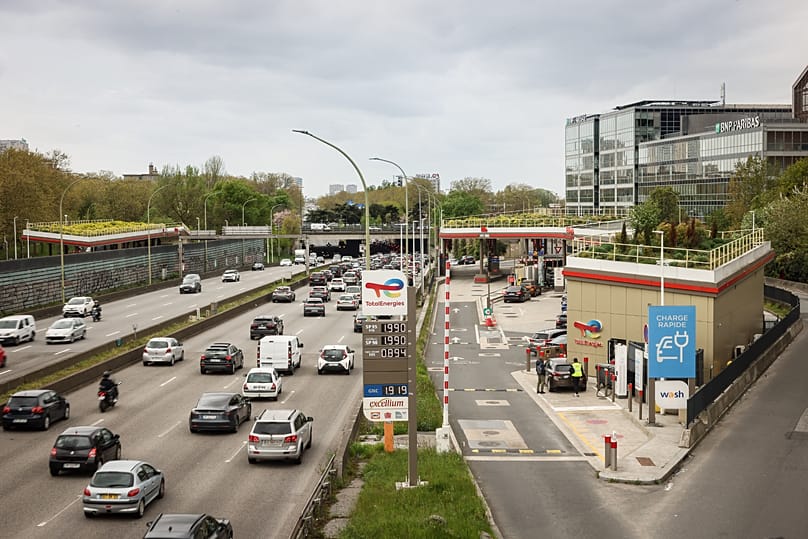
The simplest example: when you go to a TotalEnergies service station and fill your car with petrol, the CO2 that comes out of your exhaust pipe as you drive automatically forms part of TotalEnergies' indirect 'Scope 3' emissions.
The court has not, however, gone so far as to consider TotalEnergies legally responsible for all its customers' behaviour, nor, as the claimants had wanted, to order it to halt its new oil and gas projects around the world and reduce its oil and gas production by 37 per cent and 25 per cent respectively by 2030.
The City of Paris, which was among the claimants alongside France Nature Environnement, the NGO Notre Affaire à Tous and the association Sherpa, on Thursday welcomed the ruling as "a historic decision for French climate law".
"For the first time, a judge has recognised that climate risks do indeed fall within large companies' duty of vigilance, and that no fossil-fuel multinational can evade this responsibility", said Alice Timsit, deputy mayor of Paris, in a statement.
France's pioneering duty of vigilance law
This ruling is the first concrete application of the pioneering 2017 French law on the duty of vigilance, which requires very large companies to take responsibility for the impact of their activities, not only within their offices but along their entire production chain.
The law targets the giants of the economy. It applies to companies based in France that employ at least 5,000 staff within the company and its direct or indirect subsidiaries in France, or at least 10,000 staff including their subsidiaries anywhere in the world.
Until now, TotalEnergies has mainly highlighted the efforts made to reduce the emissions linked to its own activities, such as those from its production sites, offices or infrastructure (Scope 1 and 2).
Yet for an oil group, these emissions account for only a small share of its overall carbon footprint. The bulk (90 per cent) comes from Scope 3.
By requiring TotalEnergies to fully take these Scope 3 emissions into account in its climate risk analysis, the French courts have found that the company can no longer restrict itself to its direct emissions alone and must also consider the environmental impact of the use of its products.
By strengthening the transparency obligations of the French energy giant, this ruling could therefore lead to closer scrutiny of its climate strategy and prompt further legal action if its vigilance plan is deemed insufficient.