



























At maximum eclipse on 27–28 August, Earth’s dark umbral shadow will cover 96% of the Moon’s face - an almost total eclipse.
Europeans will be treated to a “very deep” partial lunar eclipse in the early hours of Friday (28 August) morning, just before dawn.
 ADVERTISEMENT
ADVERTISEMENT
ADVERTISEMENT
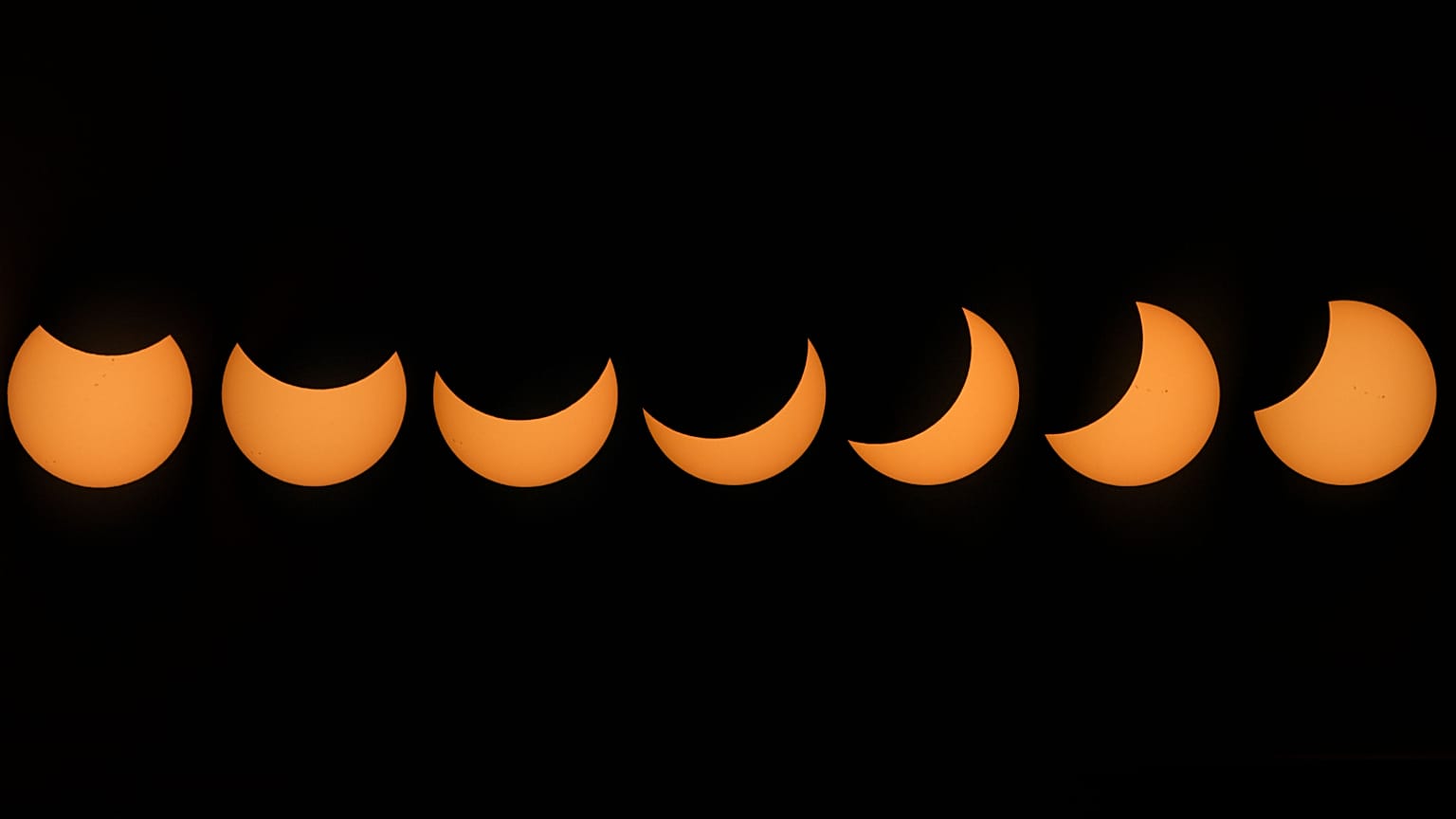
A partial eclipse always happens about two weeks before or after a solar eclipse, so this one follows the total solar eclipse that captivated Europeans earlier this month.
During a partial eclipse, an imperfect alignment of the Sun, Earth and Moon means a Full Moon passes through only part of Earth’s shadow in space. The shadow grows and then recedes without ever entirely covering the Moon, creating a rare celestial phenomenon.
Friday’s is a Full Sturgeon Moon, named after North America’s largest fish. The moon could turn a rusty red as it gets 96.2 per cent covered by Earth’s dark inner shadow. The change of colour is caused by Earth: “the edge of Earth’s shadow in space has a reddish glow that comes from sunlight streaming through the atmosphere that surrounds our planet”, according to timeanddate.
You won’t need the special glasses that were necessary to safely view the total solar eclipse earlier this month. Looking directly at the moon during a partial eclipse is totally safe.
If you happen to have binoculars or a telescope, they will make the shadow clearer to see.
Location and weather will determine where in Europe that will get the best view of the eclipse. The places facing west with the least cloud cover will get the most spectacular experience.
If you won’t be able to see the eclipse in person, it will be streamed during a live show by timeanddate on YouTube.
Partial lunar eclipse: Where to see it in Spain
Just like with the solar eclipse, Spain will get the best views. The lunar eclipse will be visible from anywhere in the Iberian Peninsula, the Balearic Islands, the Canary Islands, Ceuta and Melilla, provided the skies remain clear with no clouds.
There will be a difference in viewing time, however. In central and eastern Spain, the Balearic Islands, as well as Melilla, the moon will set before the partial eclipse has finished, whereas in the rest of the country, including the Canaries and Ceuta, you will be able to see the whole process of the eclipse.
The moon will rise in Spain at 9.01pm on 27 August and set at 7.47am on 28 August. The partial phase of the eclipse will begin at 4.34am and end at 7.52am – one hour earlier in the Canary Islands.
The peak of the eclipse, which is when Earth’s shadow covers the largest percentage of the moon, will occur at approximately 6.12am, just before sunrise. At that moment, Earth’s shadow will be projected onto 93 percent of the lunar disk.
Partial lunar eclipse: Where to see it in Italy
Based on current weather forecasts, some of Italy’s biggest cities are set to have the best views: Naples, Rome and Venice are forecast to have the least cloud cover, meaning they should see a 93 per cent eclipse. Bologna is one of the next best, followed by Turin. Genoa and Milan will also have 93 per cent coverage but they are forecast to be very cloudy.
The partial eclipse will start at 03.23am in Italy, it will be at best coverage at 06.12am and it will end at 09.01am.
Partial lunar eclipse: Where to see it in France
Current weather forecasts are predicting a lot of cloud and some rain for Friday morning in France so it may not be the best place for a viewing.
The moon will not begin crossing into Earth’s shadow until around 03.20am, with the colouration effects seen around 04.34am. The peak of the event – when the majority of the moon is in the Earth’s shadow and the red colour its deepest – will take place at around 06.13am. At this point however, the moon will be only around 8° above the horizon, and early morning sunshine may interfere.
Marseille and Strasbourg currently have the best chance at a viewing as they’ll have low cloud cover, though there may be heavy rain or lightning.
Partial lunar eclipse: Where to see it in Portugal
Anyone in Portugal wanting to catch the partial lunar eclipse from the start will be in for an early start - it begins at 02.23am local time and ends at 08.01am.
Lisbon and Amadora currently have the clearest skies forecast, with Braga and Coimbra also in with a good chance.
Partial lunar eclipse: Where to see it in Germany
As with the rest of the Central European Summer Time time zone, the eclipse will be at its best at 06.13am in Germany. This is after the Moon has set and the Sun has risen in eastern Germany. It begins at 04.33am.
In the far west of the country, however, the rise and set times for the Sun and Moon are delayed by a little more than half an hour, so that more of the eclipse will be visible. The Moon’s exit from the umbra at 7:53am will, in any case, occur long after sunrise and moonset as seen from Germany, according to the Haus der Astronomie.