




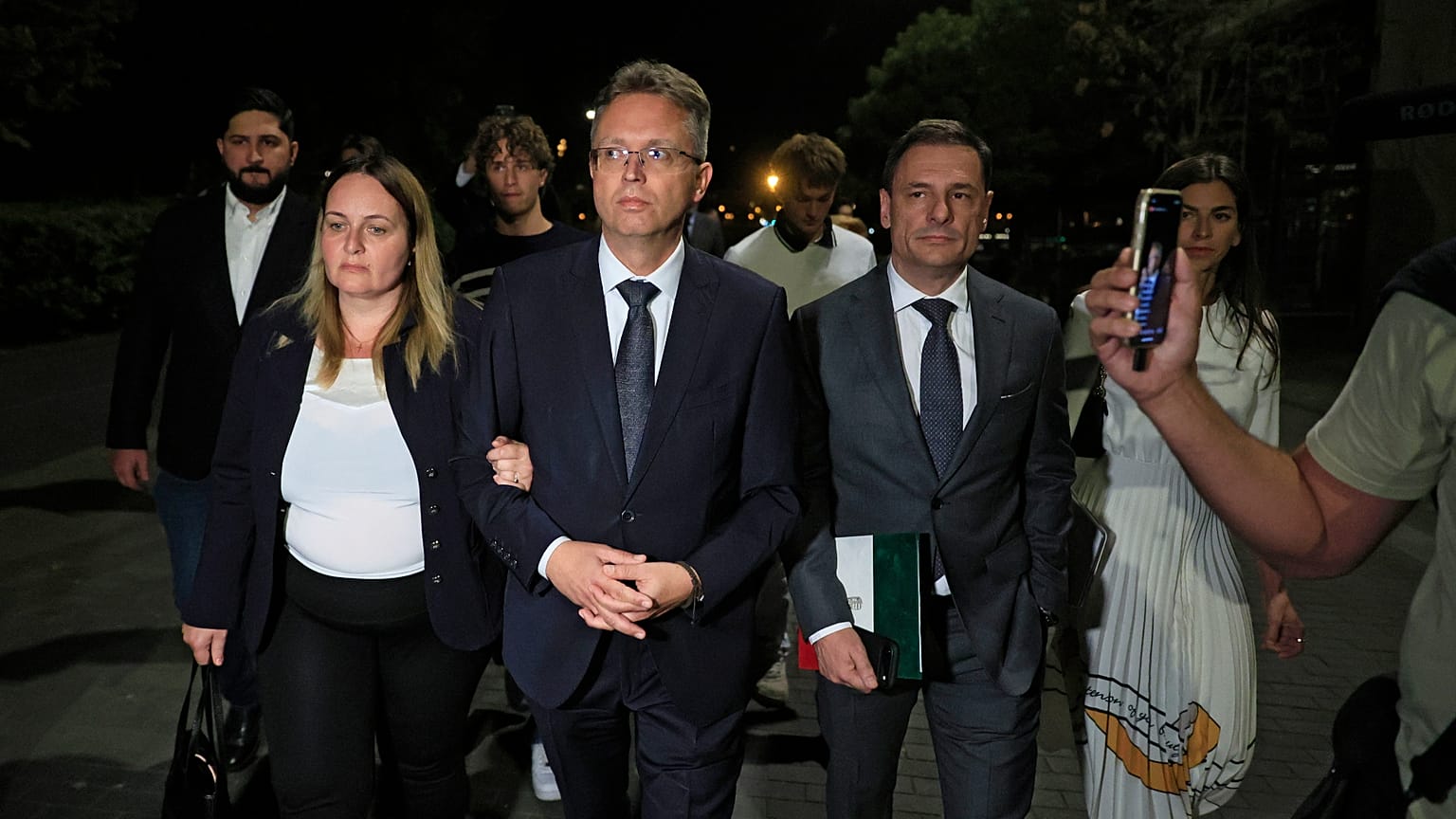













Prime Minister Péter Magyar’s “Operation Purge” has entered a new phase with the detention of two former ministers. Holding officials from the Orbán era to account was a central campaign pledge, and Magyar says the drive will now accelerate. Fidesz has denounced the effort as political revenge.
Hungarian prosecutors on Monday detained two former ministers over corruption and abuse-of-office allegations after parliament lifted their immunity.
 ADVERTISEMENT
ADVERTISEMENT
ADVERTISEMENT
The detention of Miklós Seszták and Balázs Hankó is a significant development in Prime Minister Péter Magyar’s efforts to hold officials from his predecessor Viktor Orbán’s era to account. The campaign has been dubbed “Operation Purge.”
Magyar, whose Tisza Party won April’s parliamentary election, has accused Orbán of running a “mafia state” that channelled billions of euros in public funds to his business associates. Tisza campaigned on a “Road to Jail” programme, and after forming a government, Magyar announced Operation Purge in June, aimed at dismantling what he described as state capture.
"We are launching Operation Purge, which will close those long decades when Hungary could be held hostage by organised political and economic criminal groups," Magyar told parliament.
Prosecutors accelerated several investigations into the Orbán era over the summer.
On Monday morning, parliament, where Tisza holds a majority, lifted the immunity of the two former politicians. Seszták, who served as development minister from 2014 to 2018, is suspected of taking around €30 million in bribes linked to bus tenders. Hankó is being investigated over the disbursement of €46 million in cultural funds to public figures, which the authorities largely regard as campaign financing.
Both men remain in custody as suspects and deny any wrongdoing.
"After decades of lies, millions of Hungarians experienced for the first time what real regime change and equality before the law really mean. Hungary is finally not a country without consequences," Magyar wrote on social media after the detentions. He added that "Operation Purge" would accelerate.
Political analyst Szabolcs Dull said the issue resonates with voters, arguing that accountability is central to Péter Magyar’s political message.
"This is the core issue of Péter Magyar's politics. He always had the greatest success in the campaign by promising accountability, confrontation and consequences. One of these elements is that he will hold those responsible for the past period to criminal proceedings and even send them to prison. The promise of handcuffs and bars, many times," Dull said.
Investigations could reach key allies, or Orbán himself
At the centre of the purge is the newly established National Asset Recovery and Protection Office, an anti-corruption body that can take over investigations from prosecutors, launch new proceedings and issue warrants. The Public Prosecutor's Office and the National Tax Authority are also involved in some cases.
Several other high-profile figures are also under investigation. György Matolcsy, the former governor of the Hungarian National Bank, has been questioned as a suspect in a blackmail case linked to the removal of a manager at Erste Bank Hungary.
Parliament's National Security Committee also invited summoned Foreign Minister Péter Szijjártó to a hearing on the investment agreement with Chinese carmaker BYD in Hungary. After the election, Szijjártó took a management position at BYD, prompting concerns over a potential conflict of interest. No official investigation has been opened against him.
Orbán himself could also eventually be drawn in. Lawyers say his possible criminal liability arises in the case of the Ukrainian cash convoy.
In March, at the height of the election campaign, two Ukrainian cash couriers carrying regular transfers from Vienna to Kyiv were stopped near Budapest.
The couriers were detained and a large amount of cash and gold was confiscated. The authorities consider the raid and detentions unlawful and are investigating Orbán's role. According to a former chief prosecutor, Orbán personally gave instructions to the anti-terrorist police.
"Authorities must decide whether there was a legal abuse in the Golden Convoy case or not. If Viktor Orbán is legally punished here, people will want to see it as political accountability for his responsibility for other corruption cases," Dull said.
Fidesz warns of political revenge
On Monday evening, MPs from Orbán's Fidesz party accompanied Hankó to the prosecutor's office in a show of support. They portrayed the investigations as politically motivated and accused Magyar of acting like a tyrant.
"Arbitrariness needs new victims every day. Today it's them, tomorrow it's you," Orbán wrote on social media.
"We send a message to all Hungarians: the Tisza tyrants will not break the community of the national side; we will not let them! They cannot imprison half the country!" he added.
Fidesz has also accused Magyar of dismantling the rule of law, including by removing former President Tamás Sulyok through a constitutional amendment. The party argues that Magyar’s repeated calls to punish former officials threaten judicial independence.
Dull said Fidesz was under pressure to respond constantly to voters. "Fidesz has to react to those investigations every hour to explain to its own voters why its politicians, now former ministers, are being taken into custody one by one. For this, Fidesz has built a narrative of arbitrariness, giving its voters a story that a political showdown is taking place, to keep its base together," he said.
Magyar also faces investigation
Hungary's parliament on Monday also lifted Magyar's immunity at the request of the Prosecutor's Office, in connection with a theft case. The case stems from an incident in May 2024, when Magyar confronted a man who had filmed him dancing in a nightclub and threw the man’s phone into the Danube.
Magyar sharply criticised prosecutors for pursuing the case alongside two corruption investigations involving millions of euros in public funds.
"By placing these three cases side by side without any reasonable explanation, they made it clearer than ever for every Hungarian citizen who the Prosecutor General's Office has served and with what means over the past decade and a half," Magyar said. He added that he was ready to face justice.