




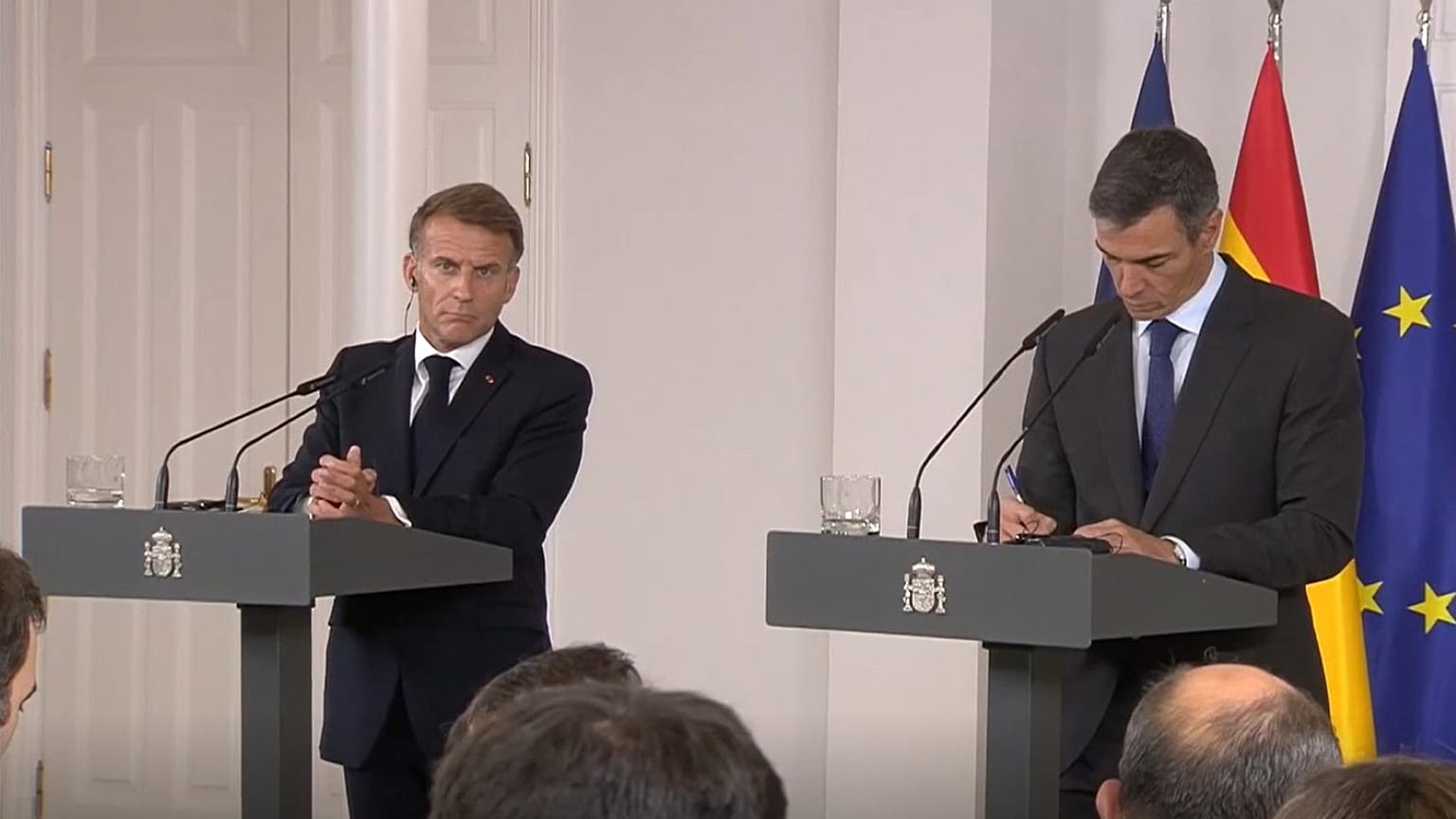














Sánchez and Macron back cooperation between Spain and France and call for greater EU unity on migration, economic and geopolitical issues, despite the Spanish Senate's rejection of the bilateral Friendship Treaty.
The Spanish prime minister Pedro Sánchez and French president Emmanuel Macron highlighted the close relationship between their two countries and urged greater European unity to confront key migratory, economic and geopolitical challenges.
 ADVERTISEMENT
ADVERTISEMENT
ADVERTISEMENT
The joint press conference at the Moncloa Palace was also marked by the Spanish Senate's rejection of the Treaty of Friendship between Spain and France.
Sánchez apologised to Macron for the Upper House's no vote and promised that parliament would approve an agreement of this kind before the end of the current term. "All I can do is apologise," the Spanish premier said of Tuesday's rejection, insisting that the treaty would be adopted again to reaffirm the "sense of brotherhood" between the two countries.
The Treaty of Friendship, signed by Sánchez and Macron in Barcelona in January 2023, had already been endorsed by the lower house of parliament and ratified by France. However, the Senate voted it down on Tuesday, with 142 votes against from the PP and Vox, compared with 106 in favour and one abstention.
The rejection came six days after the Constitutional Court ruled unanimously, on 23 September, that the text was compatible with the Spanish constitution. One of the main flashpoints is a clause allowing a member of the French government to take part in meetings of the Spanish cabinet, and vice versa. Madrid and Paris exchanged letters clarifying that such participation would fall outside regular meetings of the Council of Ministers, but the PP has maintained its objections.
The parliamentary procedure still offers ways to resolve the stand-off between the two chambers. Foreign Minister José Manuel Albares accused the PP of "sabotaging" the agreement, while the conservatives insist their stance does not call into question France's strategic importance as a neighbour, ally and European partner.
Sánchez stresses cooperation between Madrid and Paris
During his remarks, Sánchez thanked Macron for France's "solidarity" with Spain during the "difficult days" of the Ceuta migration crisis and pointed to the cooperation between the two countries in various emergency situations.
"Together we have fought a thousand and one battles in a Europe that has faced multiple crises," the prime minister said, citing as examples the joint efforts to secure the EU's Next Generation recovery funds and their collaboration during last summer's wildfires.
Sánchez acknowledged that Spain and France have had their differences, but underlined that both governments have always sought to reach agreements. In this regard, he pointed to a "very strong bond" between the two countries in defending the European project.
Macron likewise stressed the historic ties between France and Spain, recalling that their peoples have "always fought side by side". The French president also highlighted the close bilateral cooperation in areas such as the economy, defence and energy interconnection.
Sánchez responds to Vivas and defends contact with Ceuta's government
Asked about the testimony given by Ceuta's president, Juan Jesús Vivas, before the National Court, Sánchez said that although he was not aware of the precise content of the questioning, there had been constant communication between the central government and the regional executive ahead of the mass arrival of migrants.
"There was constant communication with him and with his government," Sánchez said, explaining that in the days before the incident three-way meetings were held between the central government, the Autonomous City of Ceuta and the government's regional delegation. The prime minister insisted these were not isolated contacts. "There was not one or two, but many exchanges," he said.
Sánchez also argued that no one, including Ceuta's own authorities, could have foreseen the scale of the arrivals that eventually took place. "No one anticipated, neither did they, that we might see a mass influx like the one that occurred on 30 and 31 July," he said.
On a possible visit by the King and Queen of Spain to the autonomous city, Sánchez said there would be an official announcement in due course, but declined to give a date. "You will see when the time comes," he added.
By contrast, Macron stressed that Spain had been "the victim of a multiple attack" and expressed surprise at the reaction of some European countries which, he said, failed to show solidarity with Madrid despite having demanded such support themselves during similar migration episodes. His comments were a thinly veiled reference to Italy and the government of Giorgia Meloni.
Macron calls for balance between solidarity and responsibility on migration
The Ceuta crisis featured prominently in Macron's address. The French president voiced his country's solidarity with Spain and argued that the European pact on migration and asylum must strike the right balance.
"The balance between solidarity and responsibility is very important," Macron said, calling for "robust solutions" to protect the borders, but always within the framework of EU law and in full respect of the Union's values.
Spain and France urge greater ambition for Europe
The two leaders also agreed on the need to strengthen the European project. Sánchez called for a "far more ambitious" EU budget, while Macron argued that the bloc's finances will be crucial in meeting future challenges.
The French president also emphasised the need for EU member states to maintain a common line on trade relations with China. "If we are not united as Europeans, we have no chance of succeeding," he warned.
Sánchez urged deeper European cooperation on security and called for "more transparency" around algorithms and "more control" over fake accounts on social media. He also argued for new mechanisms to shield member states from possible "foreign interference in electoral processes".
Defending multilateralism and a rules-based international order
On foreign policy, Sánchez stressed that Spain and France share a "global vocation" and hold similar positions on a number of crises, including the war in Iran and the Israeli-Palestinian conflict. Both governments back a two-state solution.
"In the face of the law of the strongest and the fascination with authoritarianism, Spain and France will always stand up for multilateralism and a rules-based international order," Sánchez said.
The Spaniard argued that cooperation between the two countries stems both from their principles and from the interests. "A world without rules is a more insecure world for our citizens," he added.
Macron likewise underlined the need for a common European stance and praised coordination between Paris and Madrid in defending sovereignty, peace and international stability.
Macron's visit has thus served to publicly reinforce the alliance between Spain and France, despite the political strains surrounding the Treaty of Friendship. Both governments have stressed the need to maintain close cooperation and a coordinated position on the main challenges facing Spain, France and the European Union as a whole.