
































French students' grievances include long school days, overcrowded classrooms, outdated facilities and teacher shortages. Their anger has resonated across Europe, with students in Belgium and Italy also staging protests.
Three weeks into France’s student protests, questions are mounting over whether the demonstrations will fizzle out or evolve into a broader social movement.
 ADVERTISEMENT
ADVERTISEMENT
ADVERTISEMENT
The protests and school blockades began in Paris’s suburbs in mid-September, before rapidly spreading nationwide. Dramatic images of students climbing the iconic column at Paris' Place de la Bastille on Thursday managed to capture audiences worldwide.
The scenes carried historical weight given that the square stands on the site of the former Bastille fortress and state prison, stormed by Parisians on 14 July 1789 in a defining moment of the French Revolution.
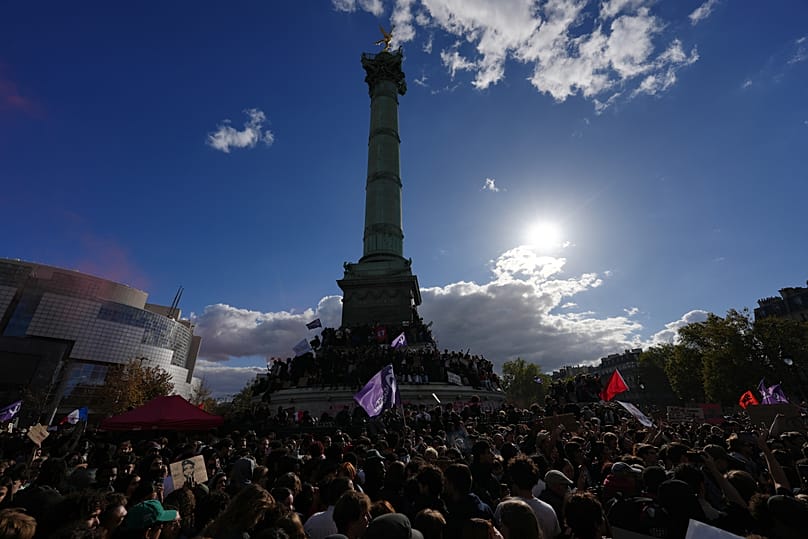
After its demolition, the Bastille became a lasting symbol of the triumph of regular citizens against political oppression. Taking to X on Thursday, hard-left France Unbowed leader Jean-Luc Mélenchon declared that the Bastille had been "retaken."
A range of student grievances lie at the heart of the movement, including long school days, overcrowded classrooms, run down schools and teacher absences. Their anger has resonated with young people across Europe, with students in Belgium and Italy also staging protests in recent days.
Could the student movement grow into something broader?
Another day of protests, backed by student and trade unions, is scheduled for Tuesday, 13 October. Meanwhile, a separate demonstration against the cost of living crisis and rising fuel prices — planned before the student movement erupted — is scheduled for 17 October.
There is speculation that the 17 October demonstration could mark the return of the yellow vest grassroots movement, which emerged in 2018 in reaction to a planned government fuel and diesel tax hike. For months, yellow vest protestors gathered every weekend to block roundabouts, motorways, and fuel depots across the country, with tense police clashes also occurring.
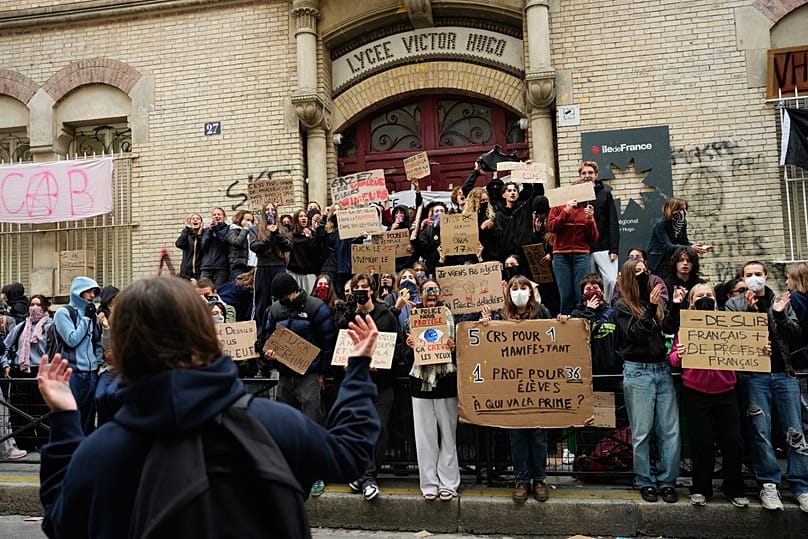
If student protests converge with wider social unrest, France could potentially face scenes reminiscent of May 1968. In recent weeks, many students have brandished banners referencing these historic demonstrations, which saw student protests escalate into a nationwide general strike.
At the time, several million workers joined the demonstrations, bringing the country to a standstill, but also sparking major wage negotiations. The movement also triggered a political crisis, prompting General de Gaulle, then France's president, to dissolve the National Assembly and call snap legislative elections in June 1968, in which his supporters secured a parliamentary majority.
Regardless, May 1968 left an indelible mark on France by dismantling rigid post-war social hierarchies. The demonstrations helped advance civil, student and labour rights, permanently embedding a tradition of mass protest into the nation's political identity.
France's tense political backdrop
At present, France's minority government is struggling to secure parliamentary support for its 2027 budget, as opposition parties resist proposed austerity measures. The country's public finances are squeezed, with the government projecting the public deficit to reach 5.4% of GDP for 2026, among the highest level in the eurozone.
The deepening cost-of-living crisis, driven largely by high fuel and energy prices, has intensified public frustration. The economic pressure on households has heightened social tensions across the country, less than six months away from the country's presidential elections — amid a highly fragmented political landscape.
According to a poll by public polling firm Ifop, carried out between 25 and 29 September, the far-right National Rally party's Marine Le Pen (35%) is currently leading for the first round, followed by Edouard Philippe (15%) and Jean-Luc Mélenchon (14%). Under these projections, the second round would see a Le Pen-Philippe face off. Other projections have predicted a Le Pen vs Mélenchon scenario for the second round.
A movement which shows no sign of abating
Despite Education Minister Édouard Geffray's announcement on Thursday that 3,000 substitute teachers would be deployed nationwide to schools facing teacher shortages, public anger shows little sign of abating. Geffray said the measure would likely cost “tens of millions of euros” for 2026.
Unions have criticised the plan as a short-term fix, warning that available substitute teachers may not match schools' needs in terms of specialisms or location. In cases where no replacement is available, classes may still go uncovered, while substitute teachers may be assigned support duties until a matching vacancy arises.
“We need to look at the details, because we have to be careful with this figure that has been thrown around," Jean-Rémi Girard, a teacher and president of the national union of schools and higher education (SNALC) told Euronews.
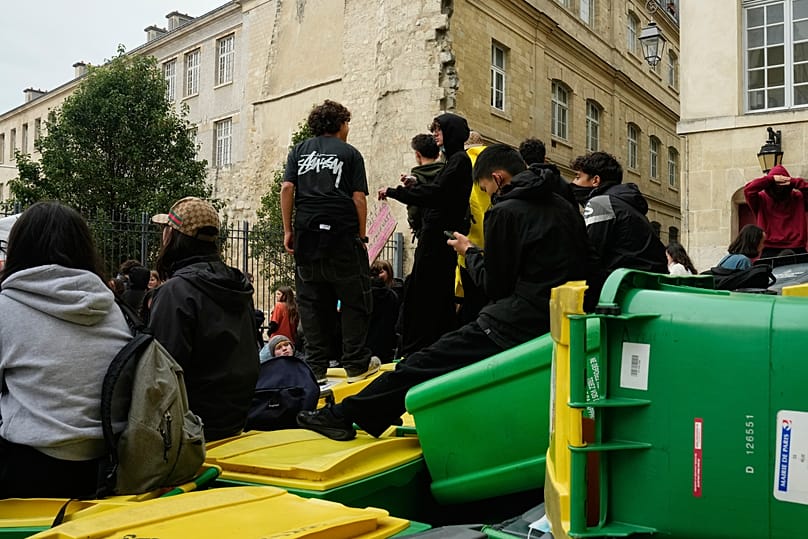
From the onset, students have been supported by teaching unions, as Girard pointed to a system in "crisis."
"We are increasingly struggling to replace teacher absences, French classrooms are among the most crowded in Europe, classrooms aren't properly equipped during heat waves. These are things we already know."
"The starting point is that the school system is in crisis, and it has been for a long time."
Major trade union federations in France have also rallied alongside students. Following Thursday's protests, the CGT, one of the country's largest trade unions, highlighted a range of demonstrations, some of which were unrelated to the student movement, declaring: "The struggles are multiplying, and the balance of power is shifting!"
Parallels with past student protests in France
Paolo Stuppia, professor of sociology and politics at Sciences Po Paris, drew parallels between the current demonstrations and past social movements in France, citing a range of movements including May 1968.
"It’s not new for students from the suburbs to rally around demands that are specific to them, and then for those demands to be taken up by other secondary schools located closer to the city centre."
For Stuppia, the fact that students from private schools have also participated in blockades marks a new departure for student protest movements. Many observers were also surprised that students from the Université Paris-Panthéon-Assas, which is viewed as having a conservative student body, staged a blockade on Thursday.
Nevertheless, Stuppia warned that the movement's momentum could be impacted by upcoming school half-term holidays in France.
"When there’s a two-week school break, it becomes harder to get a movement going again afterwards, because everything has been on hold."
A movement which has expanded in response to police violence
While many demonstrations have been peaceful, others have been marred by sideline riots and clashes with law enforcement authorities. According to figures shared by France's Ministry of Justice on Friday, there have been 6,877 arrests since the beginning of the movement, with 86% involving minors.
The scale of arrests is striking compared with those made in the initial weeks of the yellow vest movement in 2018, which saw 4,596 people placed in police custody during its first month.
Rights groups have condemned police brutality following a wave of shocking injuries to students.
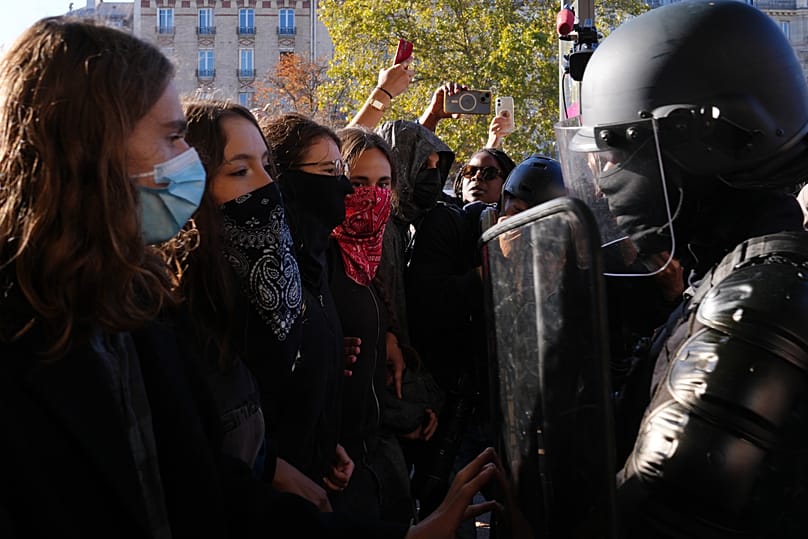
Outrage has grown over cases including a 15-year-old schoolboy who lost his left hand to a police stun grenade, a 16-year-old partially blinded by a rubber bullet, and a 14-year-old who suffered a shattered jaw and lost multiple teeth after being struck by a tear gas canister. The incidents are under internal investigation, with a total of 24 currently being conducted by the French police disciplinary body.
A United Nations spokesperson declared on Friday that the organisation was concerned about the situation in France, calling for demonstrations to remain peaceful and for the use of force to be proportionate.
Meanwhile, according to authorities, 761police officers and gendarmes have been injured since the beginning of the protests. Across the country, several schools have been damaged, burned or ransacked. In some cases, rioters have infiltrated the demonstrations.
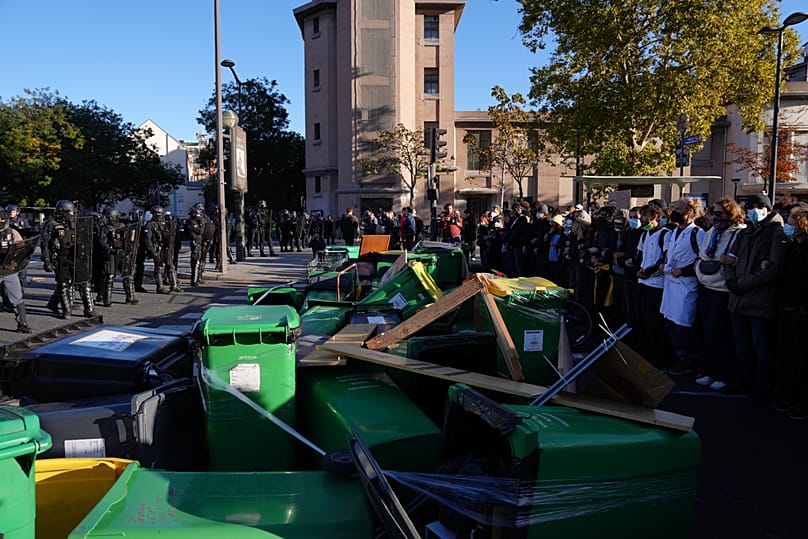
For Stuppia, the level of police repression in recent weeks was "unprecedented" since May 1968 protests.
Meanwhile, Valérie Becquet, a sociologist at CY Cergy Paris University and co-author with Paolo Stuppia of "Geopolitics of Youth: Engagement and (e)Mobilisation", said police brutality has helped draw adults into the movement.
"Adults [trade unions and parents] have been marching alongside students, but have also intervened through contacting lawyers and magistrates, in response to violence and possible human rights violations."
However, she said that there was also a portion of the adult population which viewed the protests with "disdain" and "dismissed or discredited" them.
Increasingly politicised protests
In a TV address on Wednesday evening, Prime Minister Sébastien Lecornu lamented the “violence, students and staff being attacked, police officers and gendarmes injured, schools set on fire or vandalised, thousands of hours of classes lost, not to mention threats and insults.”
He took aim at “political leaders who use this anger to conduct their electoral battles.” France goes to the polls for a presidential election in April. “We cannot play with the safety of France’s youth,” Lecornu said.
The government, joined by right-wing and far-right opposition parties, has accused Mélenchon and his France Unbowed party of exploiting and manipulating young people for political gain. Mélenchon has maintained that while his party supports the movement, it is not organising the protests and wants them to remain peaceful.
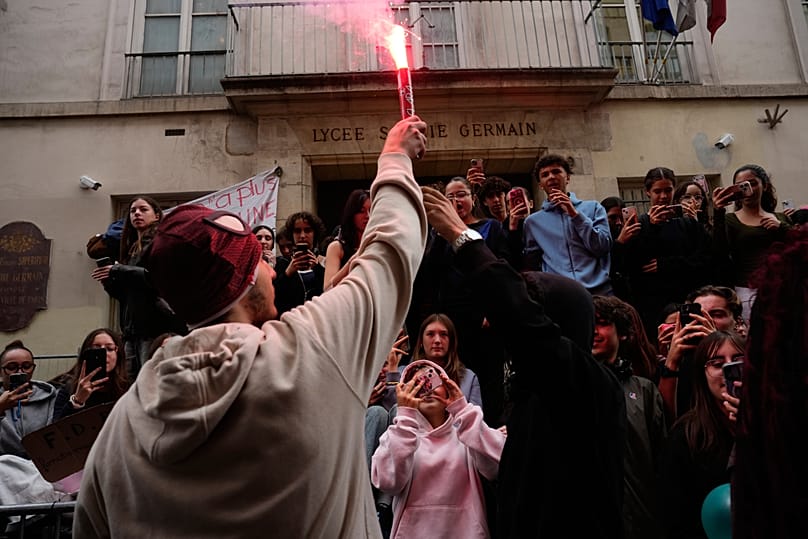
Ahead of the protests which took place on 5 October, the hard-left France Unbowed party hailed the fact that “student, secondary school, trade union and professional organisations" were "converging across the country."
For Becquet, although certain political leaders have been accused of “instrumentalising” student protests, secondary school students are on the whole able to distinguish between genuine political support and attempts to exploit the movement.
"There are people who have no particular interest in the movement, as you can see. Some are on the left, while others think 'well, this could be useful to us.'"
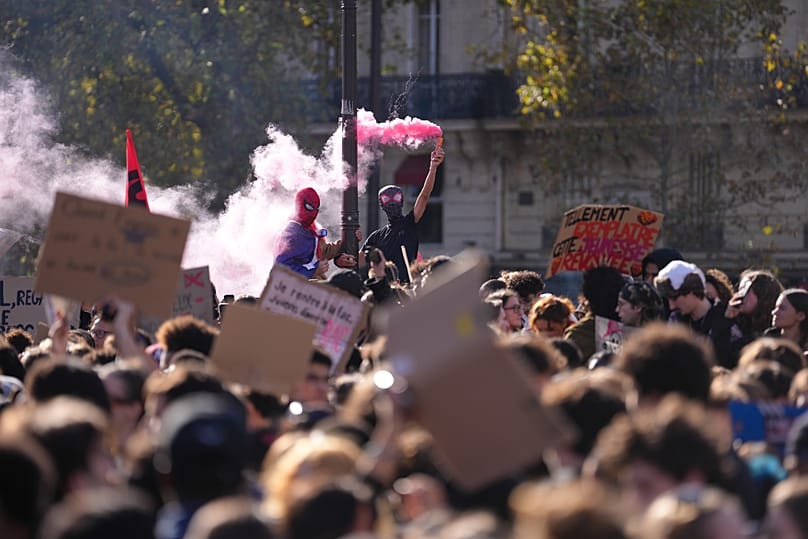
"Because of the way things work, and the way young people are treated — how they are dismissed and criticised — it ultimately creates opportunities for political intermediaries."
She warned that the protests could evolve into a broader social movement, given that frustration over school conditions reflect deeper anger about inequality across French society.
"There are inequalities at all levels, with gaps widening between different social groups."
"Given the rising cost of living, and the fact that working-class people already face numerous daily challenges, such as long working hours and commuting distances, in terms of social inequality, we are at a critical point."
Students share protests 'firsthand' on social media
Student demonstrations have spread rapidly across the country in part because footage of the initial demonstrations staged in the Paris suburbs went viral on social media.
According to Olivier Ertzscheid, senior lecturer in Information and Communication Sciences at the University of Nantes, social media allows students to organise themselves, but also to document protests firsthand from the ground.
"Social media allows them to document reality, to provide firsthand accounts of what is happening, both when things go well and when, unfortunately, they do not. Police investigations are now open, and social media images can be used as evidence, or at least play a part in the legal process."
Ertzscheid said that social media is also actively fostering a sense of connection and shared identity among protesters, which drives momentum.
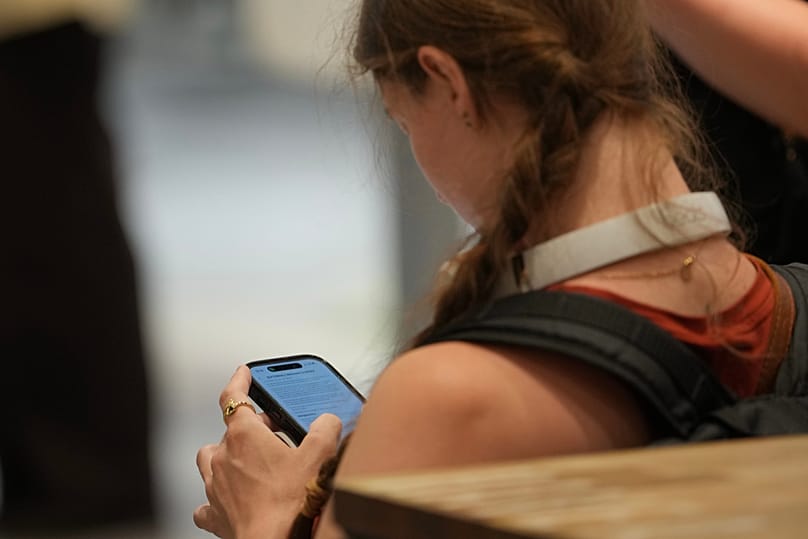
"It is a way of building a sense of group identity and expressing one’s social connections, including their political awareness or at least civic engagement. This notion of young people's sense of belonging and social interaction is at play here, and these are very important in an age where the use of social media is so widespread."
Given that a large proportion of young people in France and across the world rely on social media as their main news source, the medium has also played a role in informing their perception of the protests, as well as the government's response.
Ertzscheid said there are no "hard and fast rules" governing how protests might evolve in coming weeks.
"Whatever happens next with this movement, we know that the media and social networks will act as echo chambers. By itself, no social media platform — however powerful it may be — is strong enough to trigger a movement. But these platforms are certainly helping with visibility and allowing students to get organised very quickly."
He described several different "converging" agendas ahead of upcoming protests in France, stating that "it is possible, that all these different starting points for anger or discontent could eventually converge. But equally, it is entirely possible that the student movement will fizzle out.”