

In France, pump prices are among the highest in the European Union. The government has moved to cut the price per litre by 12 to 18 centimes, the prime minister said on Monday.
Diesel prices in France will fall by up to 18 cents per litre from Sunday 1 November as the government releases fuel from its strategic reserves. The prime minister promises savings "of around €10 for a full tank".
 ADVERTISEMENT
Sébastien Lecornu announced the measure on X on Monday 12 October after meeting fuel distributors.
"Facing a crisis we did not choose, [...] the state is shouldering its responsibilities," he said.
The reduction will also apply to domestic heating oil, diesel sold to transport professionals and off-road diesel used by farmers, fishers and construction workers.
The measure will run until the end of January. The government will sell 10 million barrels of diesel at cost price from its strategic reserves, bought before the start of the war in Iran at €0.28 per litre.
53 litres of diesel for one day’s wages
Government support seemed inevitable. France is currently one of the EU countries where pump prices are highest, with an average of €2.355 per litre of diesel as of 5 October, according to the comparison site fuel-prices.eu. That is well above the EU-27 average of €2.149 per litre. Only Finland (€2.553), the Netherlands (€2.506) and Denmark (€2.488) are more expensive.
However, the surge in prices at the pump is not limited to France. Prices are also reaching record levels in neighbouring countries. In Belgium, a litre sells for an average of €2.349, compared with €2.254 in Germany and €2.273 in Italy.
Spain, meanwhile, is one of the countries with the lowest average price, with a litre selling for €1.918.
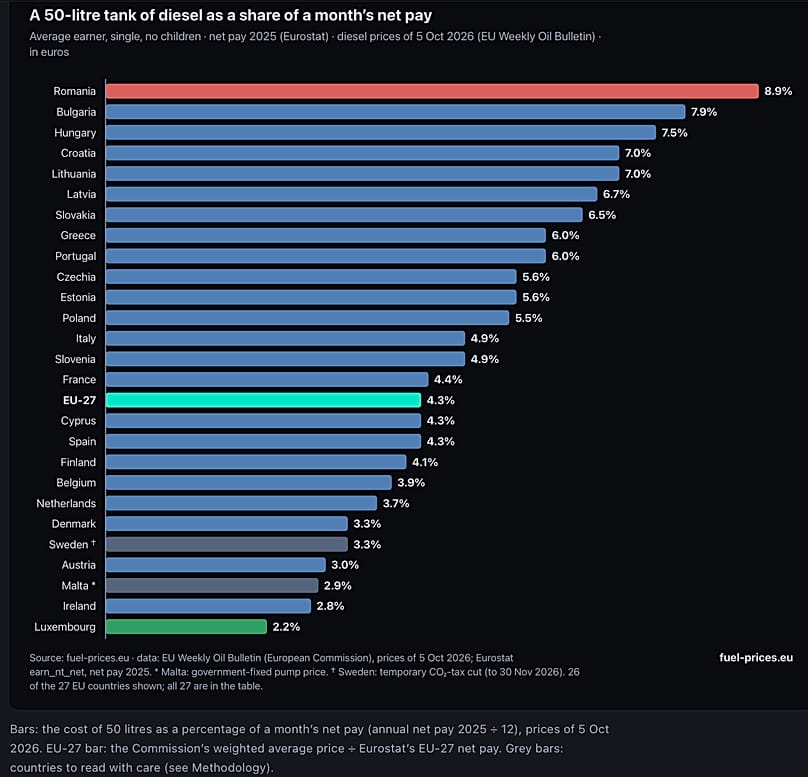
But the price displayed at the pump is not enough to gauge how hard the bill hits motorists. Wage levels also play a decisive role. While Spain appears to be doing better, a worker on the country’s average wage can buy 54.2 litres of diesel with one day’s pay. In France, one day’s pay buys 52.8 litres, compared with 47 litres in Italy and 62.3 litres in Germany.
And when it comes to filling up the tank, France sits around the EU average, with a full tank equivalent to 4.4% of the average net monthly wage.
The situation is broadly similar for petrol. France is among the countries where a litre is most expensive, at an average of €2.212 on 5 October. Here too, the country’s average prices are much higher than those in the EU (€2.006), but below the average price per litre in Denmark (€2.605, a figure that takes into account potential discounts), the Netherlands (€2.432) and Finland (€2.370).
However, France is also close to the European average when petrol prices are compared with average wages. One day’s pay buys 56.2 litres, compared with an EU average of 57.4 litres.
Heating oil far pricier than the European average
Motorists are not the only ones bearing the brunt of soaring energy prices. As winter approaches, heating costs are also a source of concern for households that use heating oil. On 5 October, 1,000 litres of domestic heating oil were selling for €1,907.08 in France, €165.14 more than the EU average and €179.09 more than in the euro area, according to the European Commission’s figures.
In recent months, prices in France have followed the same trend as in Portugal and Italy, where 1,000 litres of domestic heating oil now sell for €2,204 and €2,063.10 respectively.
Other countries have nonetheless managed to keep prices more affordable. In Germany, heating oil sells for €1,726.40 per 1,000 litres. In Belgium and Spain, heating oil is cheaper still, at €1,533.40 and €1,495.34 respectively, 19.6% and 21.6% less than in France.