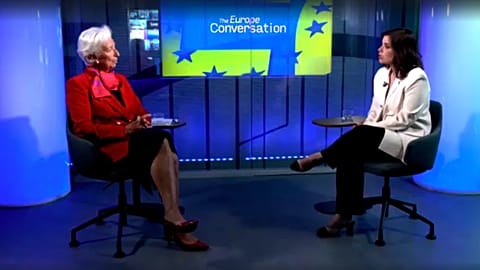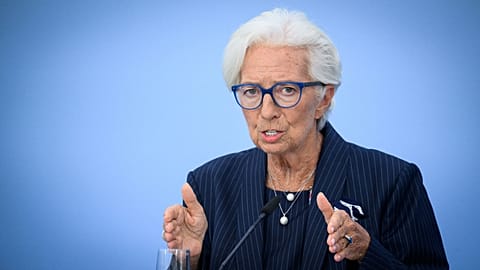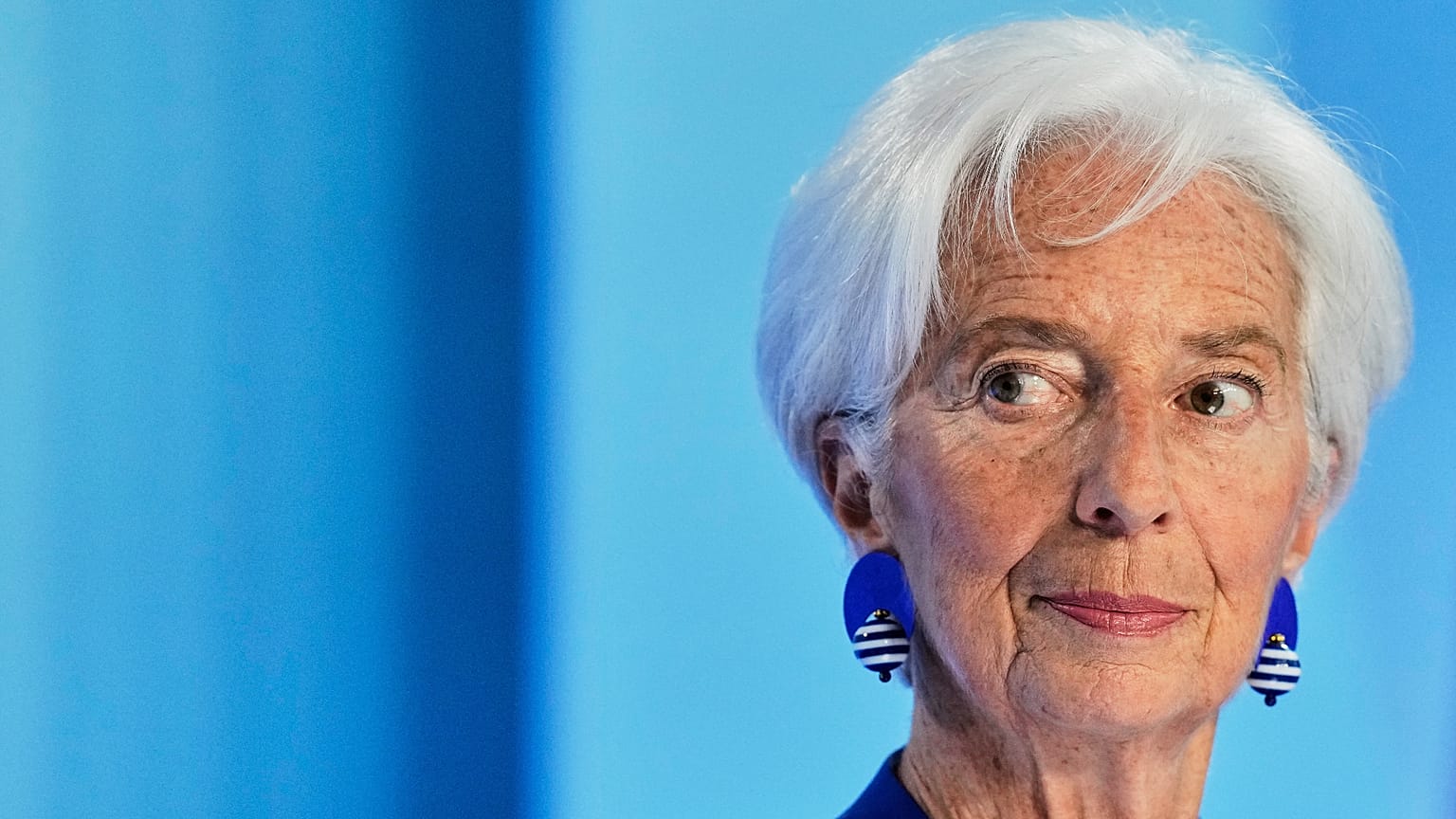


Christine Lagarde will step down on 7 February 2027, around nine months before the end of her eight-year term, the European Central Bank announced on Thursday, hours before it kept interest rates on hold at 2.5%.
Christine Lagarde will leave her post as president of the European Central Bank (ECB) on 7 February 2027, the central bank announced on Thursday, around nine months before her eight-year term was due to end.
 ADVERTISEMENT
The news immediately kicks off a closely watched race for one of Europe's most powerful jobs at a time of economic stagnation and global turmoil. Her succession will be decided by the 21 countries that share the euro.
The announcement came hours before the ECB left its deposit rate unchanged at 2.5%, as turmoil in France's bond market weighs on borrowing costs across the eurozone.
Lagarde informed the ECB's Governing Council, which sets interest rates for the eurozone, and European Council President António Costa of her decision, the central bank said in a statement.
"The Governing Council thanked President Lagarde warmly and gave her a long standing ovation," it read.
In a separate public statement, Lagarde said she was leaving with a sense of a job “well done” and an ECB that was “fit for the future.”
Separately, the ECB president also said she is stepping down before the end of her term so that she has greater freedom to express her views and to engage in non-monetary matters, because she cannot remain neutral when she sees the developments taking place in her own country and in the world, people familiar with the matter told Euronews.
"She said she can be useful as a French national, European citizen and citizen of the world," the sources added.
European Commission President Ursula von der Leyen reacted to the news, thanking Lagarde for her service and stating that "from the pandemic to Russia's war of aggression, your steady hand has helped keep our economy stable and resilient".
European Council President António Costa also thanked Lagarde, praising her "dedication as President of the European Central Bank since November 2019".
"To ensure a smooth transition to the next leadership of the ECB, the process for the appointment of her successor will be initiated today and will proceed without delay," Costa added.
French President Emmanuel Macron expressed "deep gratitude" for Lagarde's commitment and "for the determined action she has led at the helm of the European Central Bank in service of the stability of the eurozone".
Greek Economy and Finance Minister Kyriakos Pierrakakis, who chairs the Eurogroup of eurozone finance ministers, also thanked Lagarde on their behalf, saying her time in charge had strengthened confidence in the euro and crediting her leadership through difficult economic times.
Her successor will be appointed by the European Council, which brings together EU leaders.
Under EU rules, leaders choose the ECB president by qualified majority, on a recommendation from EU finance ministers and after consulting the European Parliament and the ECB's Governing Council.
Why leave early?
While the ECB gave no reason, speculation about Lagarde's early departure had been building for months.
As Euronews reported, rumours first emerged in February that Lagarde planned to leave early so that French President Emmanuel Macron and German Chancellor Friedrich Merz could oversee the choice of her successor before France's presidential election in April of next year.
Macron is barred from running for a third term, and the far-right Rassemblement National (National Rally) has been polling strongly, raising the prospect of a eurosceptic government in Paris that could complicate the appointment of a new ECB chief.
Leaving next February gives EU leaders time to settle on a name well before French voters go to the polls.
Bank of France Governor François Villeroy de Galhau announced his own early exit in February, reportedly for similar reasons. However, Lagarde had kept her plans close to her chest for months.
The departing ECB president said in February that chairing the World Economic Forum, the organisation behind the annual Davos meeting, was "one of the many options" for her future, and in July she told Euronews that she was "not a candidate for anything" dispelling speculation that she would run in the French elections.
The race to succeed Lagarde
Two names currently lead the race to succeed Lagarde.
Pablo Hernández de Cos, a former governor of the Bank of Spain who has run the Basel-based Bank for International Settlements since 2025, was put forward by Madrid in July in Spain’s first-ever bid for the ECB presidency.
Earlier this month, he also won the backing of Spain's main opposition leader, Alberto Núñez Feijóo, whose party is leading most polls ahead of next month's snap election.
His main rival is Klaas Knot, who ran the Dutch central bank from 2011 to 2025 and is seen as a former inflation hawk turned consensus-builder. Lagarde herself has praised his "rare and very necessary" ability to foster inclusivity.
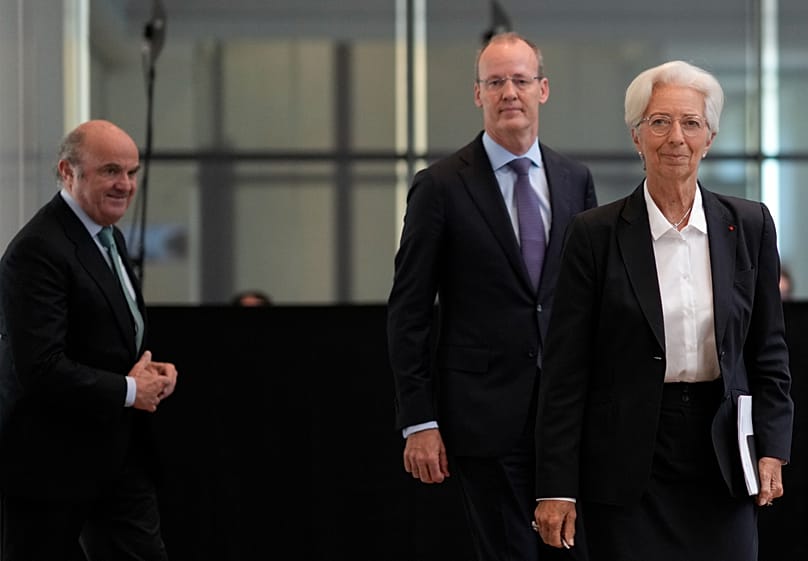
Bundesbank President Joachim Nagel has also been mentioned, though Germany has never held the job.
The presidency is also only one piece of a bigger puzzle.
Isabel Schnabel, the German board member in charge of market operations, is leaving on 3 January 2027 to join the IMF, while chief economist Philip Lane's term ends shortly after on 31 May 2027.
That means half of the ECB's six-member Executive Board, which runs the central bank day to day, will change hands within five months, and the three posts are expected to be negotiated between capitals as a package.
Eurozone governments had until Wednesday to put forward candidates for Schnabel's seat, but this deadline has been extended until 27 November. The Eurogroup did not make an announcement but a spokesperson has confirmed it to media outlets.
France, Germany and Italy have long held seats on the board, while Spain wants to return after losing its place when Luis de Guindos' vice-presidency passed to Croatia's Boris Vujčić this year.
Germany is expected to push to keep the market operations portfolio.
Meanwhile, Paris is widely expected to aim for the chief economist job rather than a third French presidency. "France knows how to play the game so they are very likely not going to try for a third French ECB President," Carsten Brzeski, global head of macro at Dutch bank ING, told Euronews in February.
Countries traditionally hold only one seat each, meaning a Knot presidency would also likely mean fellow Dutch board member Frank Elderson stepping aside.
Updated with comments from public figures and ECB