














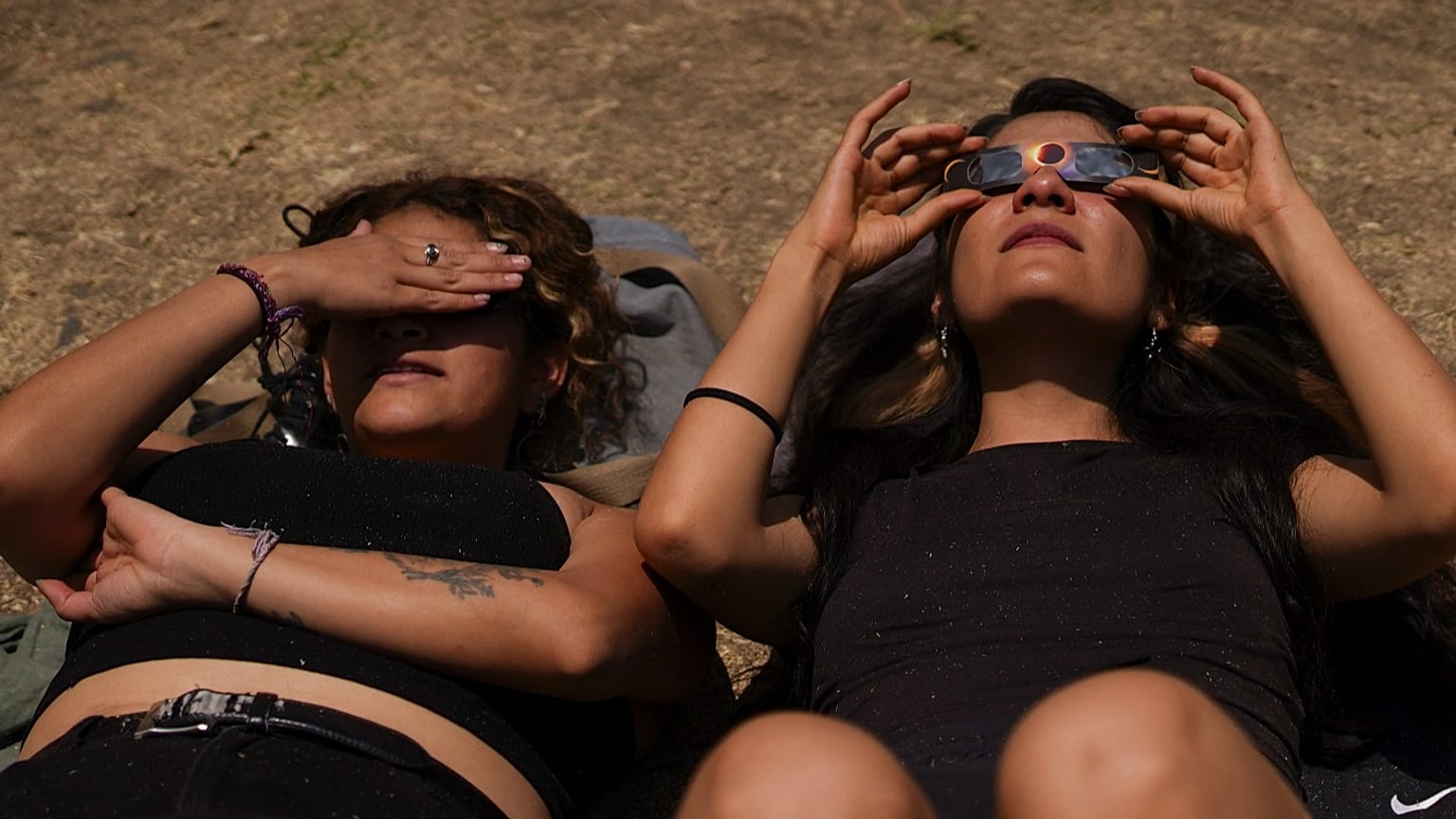













Dry eyes or a gritty sensation after the eclipse may be short‑lived, but a central blind spot can signal retinal damage. A specialist explains how to tell the difference and when to seek medical help.
Millions of people have just watched the historic solar eclipse, the first to be visible from the Iberian Peninsula since 1912, and some may have inadvertently looked at the Sun without adequate protection.
 ADVERTISEMENT
ADVERTISEMENT
ADVERTISEMENT
Should you be worried if your eyes sting after the eclipse? What if a small spot appears in the centre of your vision? Specialists warn that not all symptoms are equally significant and that the signs of a serious injury may not appear immediately.
"There are two things we need to distinguish," Dr Laura Sararols explained to Euronews. She is head of the Retina Unit at Granollers General Hospital and head of service at OMIQ in the Hospital Universitari General de Catalunya.
On the one hand, spending a long time staring at the eclipse, even when using protective glasses correctly, can make us blink less and cause dry eyes, a feeling of grit or a foreign body, and other temporary discomfort.
"This is of no consequence whatsoever", Sararols says, reassuringly. It is a phenomenon similar to what can occur after many hours of intense concentration in front of a screen and, she explains, it usually disappears within a few hours and can be relieved with tear drops.
Solar retinopathy or solar maculopathy is a very different matter. It is an injury caused by direct exposure to solar radiation that affects the retina and can particularly damage the macula, the area responsible for central vision.
And there is an added complication: when the injury occurs, it does not necessarily hurt. "At the moment when you are looking at the light, you do not feel anything. There is no pain, you have no sensation of anything," Sararols explains.
Warning sign: a spot in the centre of your vision
The symptom that requires particular attention after the eclipse is a change in central vision, according to Sararols. "The patient may notice that in the central area there is a kind of dark zone, an area that will not focus or a greyish patch that is always in the same place."
Blurred vision may also appear. The Soria Healthcare Management Board, which reports to the regional government of Castilla y León, lists among the warning signs dark spots in the centre of vision, distorted images and difficulty distinguishing colours.
The difference from mild discomfort is therefore important. The sensation of grit, dryness or a foreign body may simply be due to having kept your gaze fixed and blinked less. A persistent spot in the centre of vision or a change in what you see deserves far more attention.
Symptoms may appear one or two days later
Feeling perfectly fine immediately after the eclipse does not completely rule out an injury. According to Sararols, the symptoms of solar maculopathy do not necessarily appear in the hours immediately after exposure.
"Sometimes it is not in the hours that follow, but it can be the next day or two days later," she says. For this reason, anyone who has looked directly at the Sun without adequate protection should stay alert to any changes in their vision over the following days.
The specialist places particular emphasis on children. If a child starts complaining of vision problems after the eclipse, parents should consider the possibility that they may have looked directly at the Sun even if the child does not admit it.
"Children are not going to tell us that they were looking at the eclipse and did what they had been told not to do," Sararols warns. If symptoms appear, she recommends seeing a specialist to check whether there is an injury.
How many seconds does it take to damage the retina?
It is not necessary to look at the Sun for minutes to be at risk. A few seconds of direct viewing can be enough to cause damage, Sararols confirms.
Radiation can cause a phototoxic lesion in the fovea, located in the centre of the macula. This is why specialists stressed in the days leading up to the eclipse the importance of using specifically certified eclipse glasses for solar observation.
One of the riskiest moments came immediately before and after totality. During the brief period when the solar disc was completely covered by the Moon, it was possible to observe the phenomenon directly, but the reappearance of sunlight meant protection had to be used again straight away.
Sararols explains that this transition in particular could lead to accidental exposure among those who took off their glasses during totality and then carried on looking as the Sun reappeared. "The Sun's light quickly becomes visible again and that is the most dangerous moment," she says.
I filmed the eclipse with my phone: could I have damaged my eyes?
Filming the eclipse with your phone does not in itself mean that eye damage has occurred. The key question is whether, while positioning the device, focusing or recording, the person also looked directly at the Sun without proper protection.
Sararols draws an important distinction: only watching the eclipse on the phone screen does not expose the eyes in the same way as looking directly at the Sun. "If you set your phone up in position, press record and then just look at the screen, nothing happens," the specialist explains.
The risk lay in lifting your eyes from the screen and looking directly at the Sun while preparing or recording the footage. Those who used their phone during the eclipse should therefore ask themselves whether at any point they looked directly at the Sun without protection, rather than worrying about the simple fact of having filmed it.
It is a different story for those who watched the eclipse through binoculars, telescopes or cameras with optical viewfinders and without suitable solar filters, as these instruments concentrate radiation and can greatly increase the risk of eye injury.
What should I do if a spot appears or my vision is blurry?
If after the eclipse you notice a black or greyish spot in the centre of your vision, an area you cannot focus on, blurred vision or any other persistent visual disturbance, the advice is to see an ophthalmologist. However, there is currently no treatment with proven effectiveness to reverse solar retinopathy, Sararols explains.
"Corticosteroids are often prescribed, but they have not been shown to be effective. In reality, there is no treatment that works to solve it," she says. The lack of a specific treatment, however, does not mean you do not need to see a doctor.
The ophthalmologist can examine and document the injury and monitor how it evolves. Some patients experience partial spontaneous recovery as certain photoreceptors heal, while in other cases permanent after-effects may remain.
That is why, once the eclipse is over, Sararols leaves us with two clear messages: do not panic over a simple fleeting sensation of dry eyes, but equally do not ignore a persistent change in central vision.