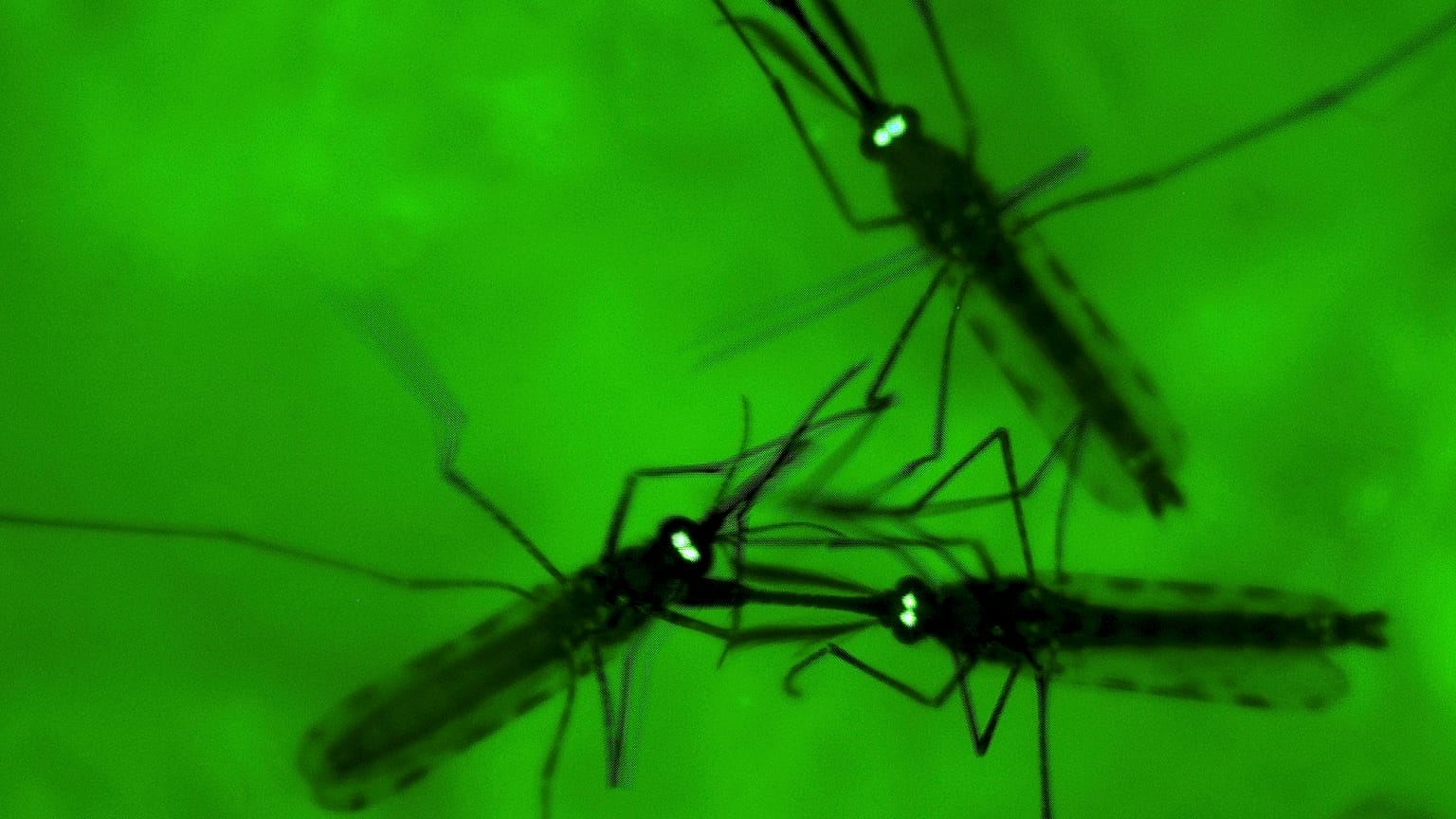













Since July 2026, eight people in Germany have contracted malaria, two fatally. Frankfurt now urges residents with such symptoms to consider malaria and consult a doctor.
Frankfurt am Main's public health authority has issued a warning after the city recorded two further cases of malaria, bringing the total number of people who have fallen ill since July to six. Malaria is a tropical disease transmitted by mosquitoes. Two of the cases in Frankfurt have proved fatal.
 ADVERTISEMENT
ADVERTISEMENT
ADVERTISEMENT
The new cases involve people from the Schwanheim district, close to the airport, and the public health authority is investigating whether there is a link. Airport employees have been particularly affected by recent infections. It is thought that mosquitoes from malaria-affected regions occasionally travel on flight routes, survive in Frankfurt and then transmit the disease when they bite.
What is malaria?
Malaria, a tropical disease, can be treated effectively if is diagnosed early. At first, however, the symptoms resemble flu or a common cold. "It is therefore crucial to consider a possible malaria infection at an early stage when such symptoms occur," the city of Frankfurt am Main said.
Typical symptoms of malaria infection include fever, shivering, headaches, and pain in the limbs, as well as gastrointestinal complaints. "Such signs are therefore often mistaken as a flu-like infection or a stomach and intestinal infection," the Robert Koch Institute also explains.
Not all types of malaria are fatal, such as malaria tertiana, quartana or Plasmodium knowlesi malaria. The most dangerous form is malaria tropica, which can be deadly without prompt diagnosis and treatment and Germany's Federal Foreign Office describes it as a life-threatening disease.
The illness is not contagious from person to person; transmission requires the bite of an infected mosquito. When malaria is not contracted in an endemic area but instead reaches other countries via mosquitoes carried on flights, it is often referred to as airport malaria.
Recommendation: consult a doctor if you develop unexplained fever
People who work at Frankfurt Airport or in its surroundings, spend time there or live close to the airport should see a doctor if they develop unexplained fever.
During the consultation, it is important to mention their place of residence or any stay in the vicinity of the airport.
Residents of Frankfurt am Main can also obtain information via the public health authority's hotline, which can be reached by phone from 9 am to 6 pm on 069/212-30030.
Preventive measures are also possible by protecting yourself from mosquito bites, for example, through the use of insect repellents. Products containing diethyltoluamide (DEET) and icaridin have so far proved effective worldwide, according to a guide from the Federal Foreign Office. Wearing long clothing and using insect nets can also help over the longer term.
Airport malaria in Europe
According to the Robert Koch Institute, cases of airport malaria are very rare in Germany. A recent study also shows that more than 99% of malaria cases recorded in Europe were imported from endemic regions.
From 1969 to early 2024, databases recorded 145 malaria cases in which the patients were infected within Europe. More than two-thirds of these were classified as airport malaria. The countries most affected were France (52 cases), Belgium (19 cases) and Germany with nine cases, eight of them in Frankfurt and one in Munich.
Here, too, many of those affected had links to an international airport. According to the city, the two newly infected people from Frankfurt's Schwanheim district are currently being treated in hospital.