

















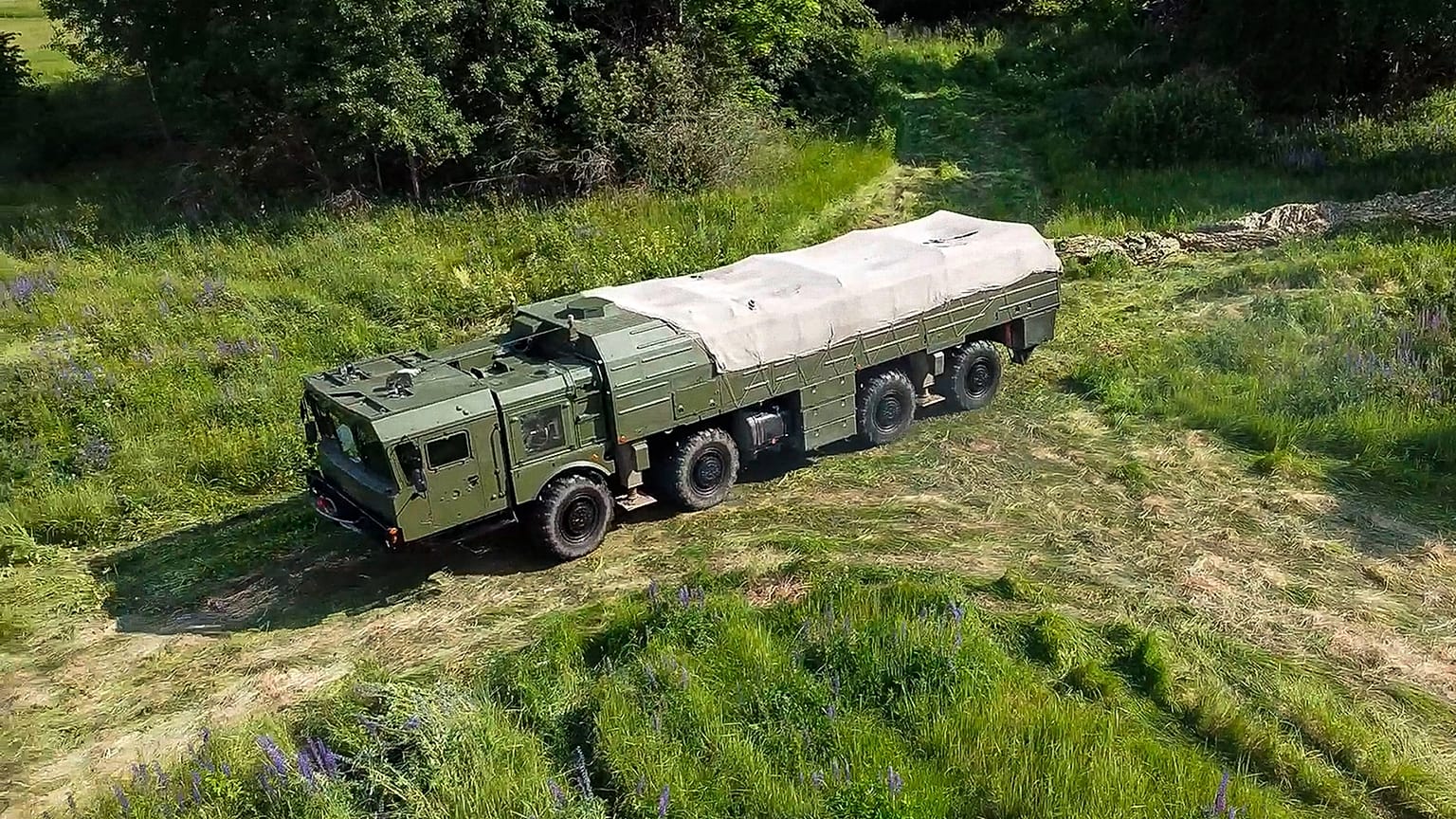














Russia has delivered nuclear munitions to field storage facilities in Belarus as part of major nuclear drills amid tensions with European NATO members sparked by drone incursions in the Baltic.
Russia delivered nuclear munitions to field storage facilities in Belarus as part of major nuclear drills, the defence ministries in Moscow and Minsk announced on Thursday.
 ADVERTISEMENT
ADVERTISEMENT
ADVERTISEMENT
They have also released what they described as “video evidence” — a clip showing military vehicles driving into a forested area at an undisclosed location and missiles being loaded onto launchers.
The Iskander-M, a mobile guided-missile system code-named "SS-26 Stone" by NATO, is intended to replace the Soviet-era Scud. Iskander-M's guided missiles have a range of up to 500 kilometres and can carry conventional or nuclear warheads.
Belarus defence ministry said the video shows **“**the delivery of nuclear munitions to field storage points in the operational area of a missile unit in the Republic of Belarus as part of military exercises."
The three-day nuclear drills which started on Tuesday are taking place across Russia and Belarus at a time when the Baltic states continue to be rattled by repeated drone incidents.
Russia's defence ministry announced on Tuesday that the exercises, running until Thursday, involve 64,000 military personnel and 7,800 pieces of equipment, including more than 200 missile launchers, over 140 unmanned aerial vehicles, 73 surface ships and 13 submarines, eight of them strategic submarines capable of carrying missiles.
Belarus opposition leader Sviatlana Tsikhanouskaya accused strongman leader Aliaksandr Lukashenka of “once again putting the lives of Belarusians at risk.”
She said that "step by step," Lukashenka "is drawing the country into nuclear blackmail,” with the removal of the nuclear-free status from the country's laws, the deployment of nuclear weapons and the Oreshnik missile system and finally the joint nuclear exercises with Russia.
“Today, Russia is openly saying that its weapons are stationed on Belarusian soil. And control over them will remain in Moscow," Tsikhanouskaya said in a post on X.
Ukraine’s security service SBU said on Thursday that in response to the drills, Kyiv is stepping up security measures in northern regions to prevent Russian and Belarusian forces from infiltrating border areas and carrying out "sabotage and terrorist acts".
Ukrainian President Volodymyr Zelenskyy said in his evening address on Wednesday that he had discussed a possible Russian offensive in Ukraine's northern regions, including Kyiv and Chernihiv, during a meeting with top military commanders.