




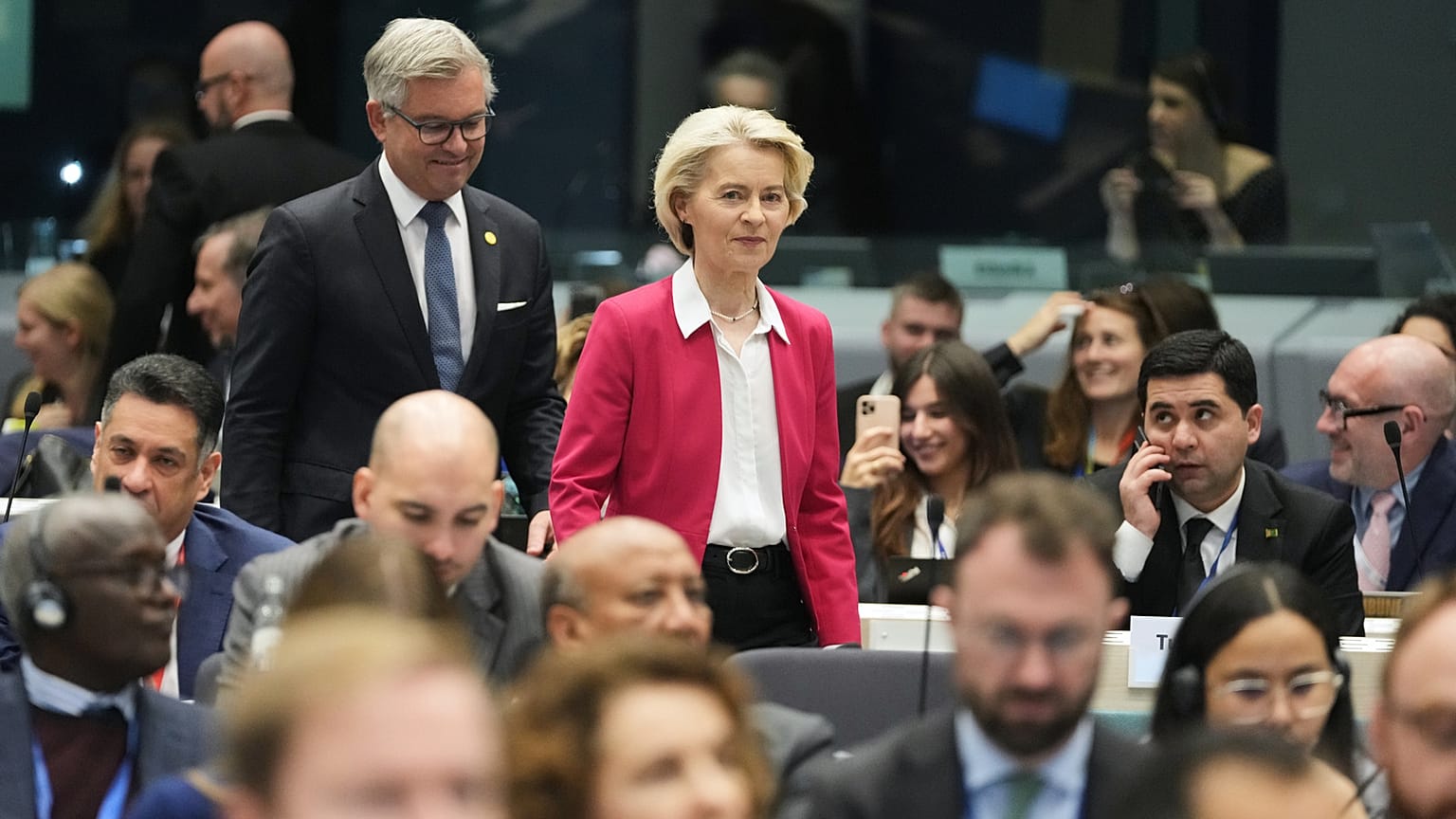













In this newsletter: Exclusive interviews with IMF Managing Director Kristalina Georgieva and the European Commissioner for Migration Magnus Brunner.
Good morning. Mared Gwyn here with your Friday newsletter.
 ADVERTISEMENT
ADVERTISEMENT
ADVERTISEMENT
If you missed the action from last night’s football World Cup opener in Mexico City’s historic Estadio Azteca – which included a sizzling performance by Colombian superstar Shakira, three red cards and a convincing win for the home team – we have awrap for you.
But first, the head of the International Monetary Fund (IMF) Kristalina Georgieva has told Europe Today that the EU faces a “difficult balancing act” as it grapples with the economic fallout of the Iran war.
“Unfortunately the conditions have worsened since we put out a projection for European growth and inflation in April,” Georgieva explained. “It is now even worse, so we are downgrading our projections for the Eurozone, and lifting again our inflation projections.”
The IMF chief also called on the EU to ensure that its budget, currently under negotiation, has the “strength to lift up productivity and growth in Europe”, adding that this means “funding together where together Europe can be more impactful” - in an endorsement of further joint borrowing. Watch.
EU migration chief seeks to align with the Pope: As the EU’s sweeping new rulebook on asylum and migration comes into force today, the EU’s migration boss Magnus Brunner has told Euronews that Brussels is in alignment with the views of Pope Leo XIV on migrants’ protections.
Asked about Pope Leo’s comments during his visit to Spain’s Canary Islands yesterday – where the pontiff told an open-air mass that history will condemn leaders who ignore migrant deaths – Brunner told my colleague Angela Skujins: “I had the chance to meet the Pope myself some months ago and I had a conversation with him exactly on that topic.”
“And yes, of course, human dignity, international law, this is all at the centre also of the (EU’s) reforms,” he added. “We have a responsibility also as a European Union to protect those people whose life is under threat in their home countries, and that's what we try to do.”
Brunner’s comments coincided Pope Leo’s visit to Spain – a country going against the grain of the EU’s anti-migrant push - where he met migrants and humanitarian workers on the island of Gran Canaria, part of the Spanish archipelago which has become a destination for a major migrant route from West Africa and across the Atlantic.
They also came just ahead of the entry into force of the EU’s Pact on Migration, a sweeping new rulebook designed to fast-track asylum procedures, shift burden from frontline southern nations and speed up the return of migrants deemed not to have the legal right to stay in the EU.
The rules are a response to mounting public pressure on migration and a notable shift to the right across European governments, but have been slammed by critics for weakening the fundamental rights of migrants and refugees.
The Pope on Thursday issued a veiled criticism of the pivot in political rhetoric on migration, saying that “human dignity has no passport and does not lose its value when crossing a border”.
One of the most controversial aspects of the EU’s overhaul is the possibility for EU countries to set up so-called “return hubs” outside EU territory where rejected asylum seekers can be deported.
The Pact has also invited criticism for failing to ensure real solidarity among member states. Only 9,000 relocations are expected through the so-called voluntary solidarity mechanism – which will allow frontline states to send asylum seekers to other EU countries not experiencing migratory pressure – which is well below the minimum target of 30,000 relocations.
Happening today: EU ambassadors will have a meeting at 18.00 CET (yes, on a Friday) to discuss, among others, their common position to open the first cluster of accession negotiations with Ukraine and Moldova. This common position is an indispensable step to celebrate the intergovernmental conference next Monday.
Diplomats tell my colleague Jorge Liboreiro that an agreement is highly possible on Friday. After Hungary lifted its veto last week, the internal process has been going on smoothly. It’s important to note that the common position was drafted months ago in anticipation of the breakthrough. It is accompanied by a rule of law roadmap and an action plan on minority rights, which was the bone of contention between Budapest and Kyiv.
But ambassadors have more work ahead of them. On Sunday, they will have their first debate on the revised budget proposal tabled by the Cyprus presidency. The so-called nego-box was officially presented yesterday by the Cypriot presidency with a 2% cut worth €32.8 billion.
Needless to say, nobody is happy. The Netherlands and Sweden, two vocal “frugal” countries, immediately dismissed it as a “no-go box” (props for the pun). "It is unaffordable, unbalanced, and with the wrong focus,” said the Dutch finance minister. The self-styled “Friends of Cohesion” are also displeased because the 2% cut also affects cohesion and agricultural funds, two politically sensitive envelopes. Italy’s Giorgia Meloni denounced the rebates for wealthy nations.
Pre-empting the backlash, Marilena Raouna, Cyprus deputy minister for European affairs, defended the proposal as a “balanced” compromise between “strong and opposing” political camps. “That was a given from the very beginning,” Raouna told reporters. “And yet, we all agree that this budget needs to allow the Union to deliver on its strategic priorities.”
Kallas defends EU foreign service before staff as debate over its future intensifies
EU foreign policy chief Kaja Kallas has come out in support of her own foreign policy department in an internal email seen by Euronews, as discussions among key European capitals over how to reform the bloc's diplomatic service grow louder.
The European External Action Service (EEAS) and the role of the High Representative for Foreign Affairs and Security Policy are facing growing scrutiny as EU governments push to make the bloc's foreign policy more agile in an increasingly volatile global landscape.
Paris has been leading efforts to sketch out what an overhaul of the EU's diplomatic service could look like, circulating a discussion paper outlining several reform options. Some proposals would curtail the powers of the High Representative, currently held by Kallas, while another would expand her authority in key policy areas.
"The relationship between the EEAS, the Commission and member states has been discussed since the service was established. Given the unprecedented geopolitical challenges we face, it is only natural that these discussions attract renewed attention and take on greater intensity," Kallas wrote in the internal email seen by Euronews on Thursday.
Maria Tadeo and Luca Bertuzzi have the details.
More from our newsrooms
EU steps in to shield households from energy price spikes ahead of new carbon costs. As the bloc extends its carbon market to buildings and road transport, Brussels will strengthen a financial tool designed to stabilise new carbon costs for heating and fuel due to kick in in 2028. Marta Pacheco has more.
Albania's PM doubles down on claims of Iranian cyberterrorism as protests continue. Edi Rama has doubled down on claims that cyberattacks by Iran are responsible for the spread of disinformation as protests demanding he resign – sparked by a real-estate coastal development linked to Donald Trump’s family – continue. Simon Ormiston has the details.
US slaps sanctions on Cuba's oil and gas company, accusing it of weaponising energy. The US government announced sanctions against Cuba’s state-owned oil and gas company on Thursday in a move expected to increase tensions between the two countries, Rafael and Salido and Gavin Blackburn explain.
We're also keeping an eye on
- EU economy and finance ministers gather in Luxembourg, and are expected to discuss extending Europe’s carbon pricing system - which puts a price on climate change-inducing CO2 emissions.
- Informal Ministerial Conference to mark the entry into force of the EU Pact on Migration continues in Nicosia, Cyprus.
- European Parliament President Roberta Metsola visits Slovakia, meets Prime Minister Robert Fico.
That's it for today. Jorge Liboreiro contributed to this newsletter. We'll be back on Monday.