




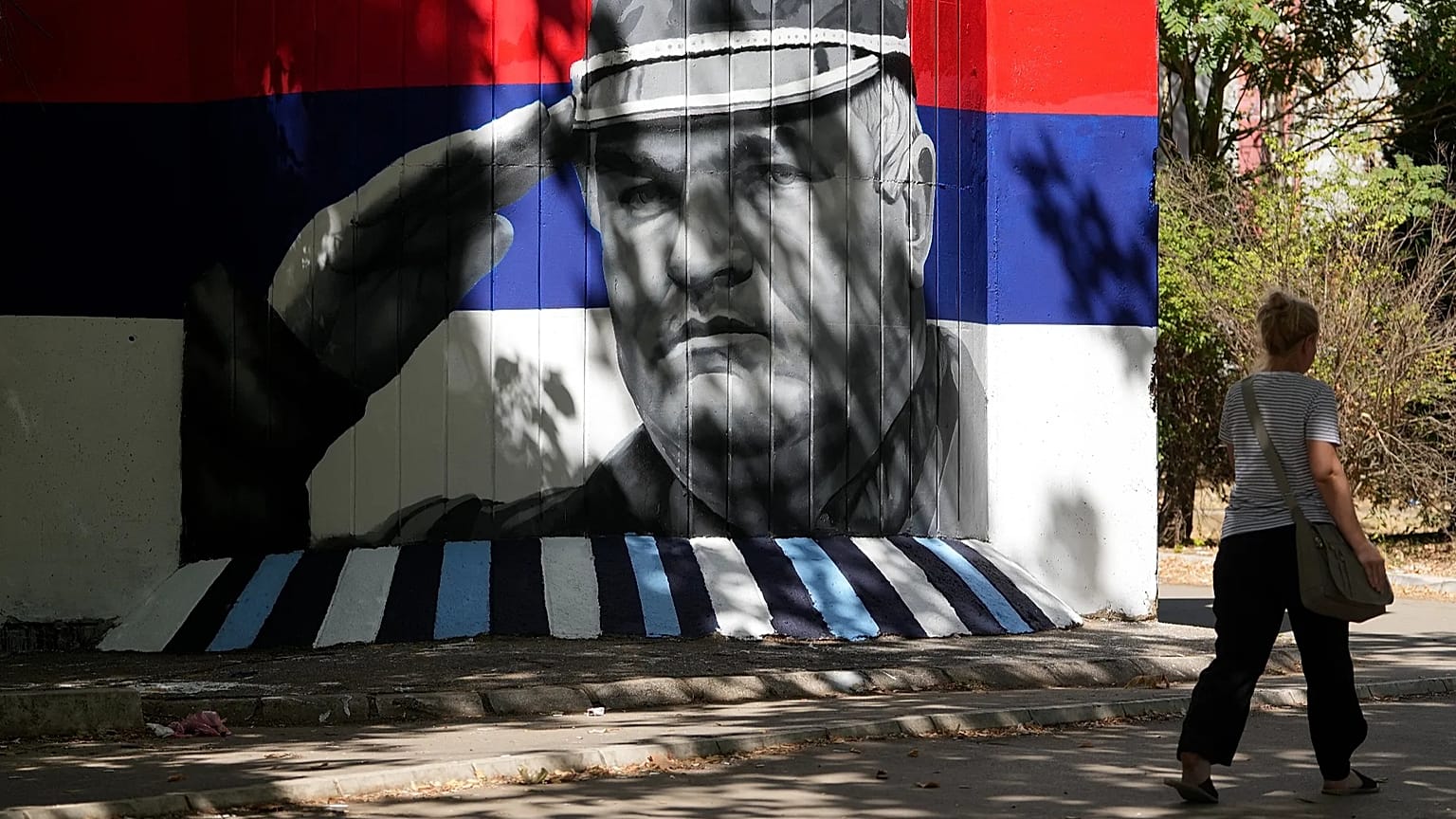














EU's enlargement chief Marta Kos says Belgrade's handling of the funeral of convicted war criminal Ratko Mladić, known as the Butcher of Bosnia, will be a test for Serbia’s EU path and could impact its membership bid.
Senior EU officials have issued a warning to the Serbian government over the funeral of war criminal Ratko Mladić, with the bloc’s enlargement chief saying that it “will be a very important test” in Belgrade’s bid to join the European Union and its future path.
 ADVERTISEMENT
ADVERTISEMENT
ADVERTISEMENT
"Ratko Mladić was convicted of genocide, crimes against humanity and war crimes. The return of his remains to Belgrade reminds Europe of the darkest pages in our recent history," European Commissioner for Enlargement Marta Kos wrote on X.
"The glorification surrounding his death is incompatible with the values on which the EU path is built," she added, announcing she had cancelled her planned visit to Serbia. "The values that underpin our common future are not negotiable."
Mladić died on 27 August aged 84 in a UN detention facility in The Hague, where he was serving a lifetime sentence for crimes against humanity related to the Srebrenica massacre and the siege of Sarajevo.
His body was returned to Serbia in a government plane on Thursday, with his coffin carried by soldiers and wrapped in a Serbian flag, shown in images broadcasted on television.
While Serbia’s Minister of Justice Nenad Vujić said last week that Mladić would be buried with state honours, President Aleksandar Vučić has since said that the family would decide on the funeral arrangements, and no official plans have been confirmed.
According to Serbian media reports, a commemoration ceremony could take place on Saturday, followed by a funeral in a Belgrade suburb on Monday.
Speaking to reporters in Dublin on Friday morning, Kos said: "Bringing the remains of Ratko Mladić to Belgrade will be a very important test."
"There are many things going on in Serbia for the time being (...) and everything could have the impact on how the member states are evaluating Serbia."
She added that the handling of Mladić's funeral would be considered in relation to Belgrade's alignment with the EU's foreign and security policy, a key requisite for joining the bloc.
“The state funeral would be unacceptable,” Ireland’s Minister for European Affairs and Defence Thomas Byrne told the press at the margin of a ministerial meeting on Friday. "I understand that there's not actually a state funeral taking place, but there may well be senior figures from government memorialising that man. That's not acceptable."
“It’s a step distancing Serbia from EU’s fundamental values of respect for human dignity, human rights and the fight against impunity – going in the opposite direction of what is expected from a EU candidate country,” Belgian Foreign Minister Maxime Prevot wrote on X.
The optics around the funeral have escalated to head of state level. At a conference held earlier this week, Croatian Prime Minister Andrej Plenković warned Serbia that giving the highest honours to the convicted war criminal would be the “equivalent of slamming the door to the European Union yourself”.
Two EU officials, speaking on condition of anonymity, told Euronews that plans for the funeral had caused concern at the heart of the EU executive in Brussels, which sees the future accession of Western Balkan countries as a strategic priority for the bloc.
Diplomatic sources told Euronews that the overall mood as European Affairs Ministers gathered in Ireland for an informal meeting on Friday was that a state funeral for Mladić or any commemoration by Serbian state officials would be completely unacceptable and inevitably weaken the support for the country's EU bid among member states.
“Anyone even considering opening Cluster 3 will think twice,” an EU diplomat told Euronews asking not to be named due to the sensitivity of the topic. “It seems very unlikely that anyone would want to push for that now.”
Earlier this summer, a push by the European Commission to advance Serbia's accession by opening talks on competitiveness and growth, known as Cluster 3, hit a wall as member states raised concerns over controversial judiciary reforms.
The bloc also estimates that Belgrade's alignment with the EU's Common Foreign and Security Policy stands at 60%, the lowest of all prospective candidates.