

















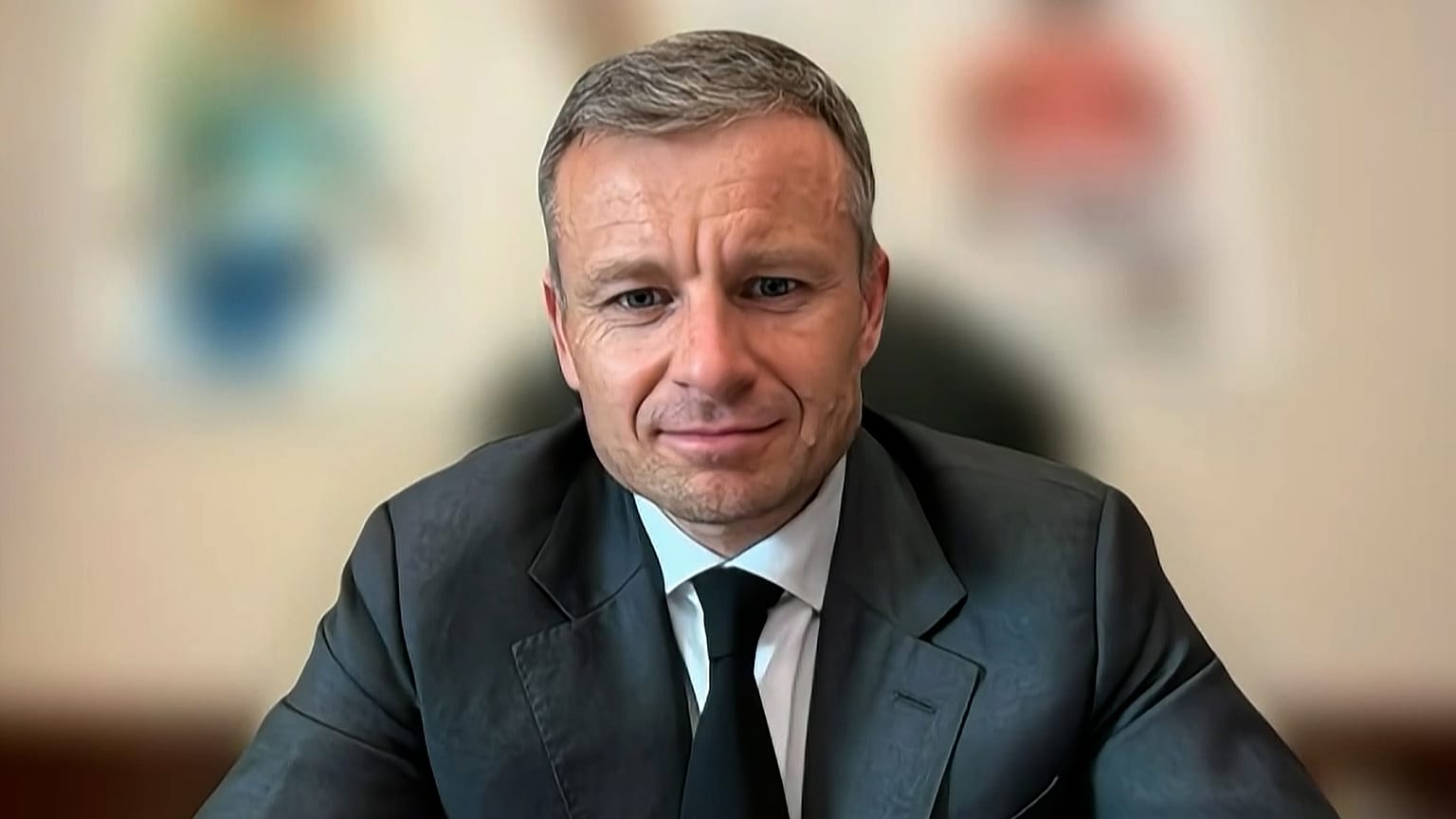














Marchenko tells Euronews exclusively that the country has not faced such budget constraints since 2022, the year the full-scale war began. He also calls for Russia frozen assets to be revived under new custodianship plan.
Ukraine's finance minister has warned that the country may have to cut non-military spending unless it can secure funding from its allies, as he urged European ministers to “think outside the box” as Kyiv faces another winter of Russian escalation.
 ADVERTISEMENT
ADVERTISEMENT
ADVERTISEMENT
Sergii Marchenko, who has overseen the country's finances since 2020, told Euronews Ukraine had not faced such a tight budget situation since the start of the full-scale invasion in 2022.
With the focus on military spending and weapons procurement, other areas of the budget could be affected and disbursements delayed unless a solution is found.
“We already see some liquidity issues, and we envisage some shortages in our budget,” he told Europe Today. “It means we may have to postpone some payments not related to the war because of a lack of liquidity. There will be consequences.”
Asked whether this could affect external creditors, Marchenko said it would not.
He said, however, that the impact could be felt at the local level, particularly when it comes to building shelters and constructing infrastructure, which he described as “still important” as the country prepares for another winter of Russian attacks.
“We haven't had a situation like this since 2022; we really suffered from the shortage of liquidity. Right now, we are getting far too near to the same scenario we had in 2022.”
He told Euronews that the intensity of Russian attacks on Ukraine had escalated sharply in August. Marchenko said he is working on a new budget on the assumption that the war will continue into 2027, with an estimated funding shortfall of $32.6 billion to be covered. He said the IMF, which visited Kyiv this week, sees similar numbers.
“The war has intensified very quickly. We realise that ourselves. It is a totally different reality compared with last month, with the recent attacks on our logistics. We expect a very hard winter. Escalation means we have to find the means to survive it,” he said.
'Thinking outside of the box'
Ukraine's finance minister urged European ministers to think creatively about solutions and consider a new Ukrainian plan to tap into approximately $300 billion of frozen Russian assets. The plan was rejected by EU ministers last December as they struggled to bridge their differences, with a €90 billion loan jointly financed decided instead.
Last week, a group of EU countries led by Sweden revived the plan, arguing that the cost of the war effort must be distributed fairly among European taxpayers. Since President Donald Trump took office, the EU has largely been left alone in footing the bill.
Marchenko welcomed the move and said he hoped more countries would rally around it before a scheduled meeting of euro area finance ministers takes place in September.
He said the new Ukrainian plan, which would shift custodianship of the assets currently held in Belgium, had introduced “totally new elements” to mitigate the legal risks for the Belgian government and Euroclear, which holds the assets.
“We want to discuss it; the plan creates new conditions where it is not the responsibility of Belgium to face court disputes with Russia, but the joint responsibility of the 27.”
Still, Ukraine and its allies in favour of the plan, including neighbouring Poland, Sweden, the Netherlands and Spain, face an uphill battle to revive the idea.
Last December, amid serious concerns from the European Central Bank and strong resistance from key member states Italy and France, the EU shelved a long-fought plan to deploy the frozen assets.
Fear Russian retaliation, reputational damage to the euro area, and lengthy legal disputes over possible confiscation claims from Moscow, were cited among the reasons.