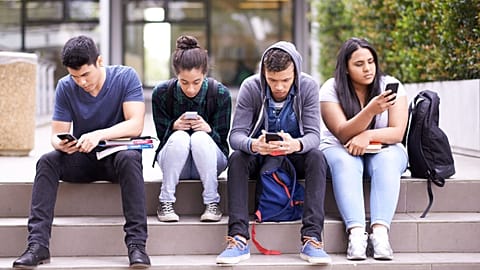





























European countries such as the UK, Portugal, France, Spain, Italy, Greece, Finland and Germany are considering restrictions on children’s social media.
The United Kingdom is the latest country to ban social media for children under 16.
 ADVERTISEMENT
ADVERTISEMENT
ADVERTISEMENT
The government made this decision after "thousands" of parents told them during consultations that their children "are addicted to social media and ... trapped in a cycle of endless scrolling that displaces play, sleep and time with the family," prime minister Keir Starmer said in a video posted to social media platform X on Monday.
"We haven't rushed into it, we have looked carefully at the evidence," Starmer said.
Australia was the first country to introduce 16-and-under social media restrictions last December. The laws restrict children from creating or keeping accounts on platforms such as Facebook, X, Snapchat, Instagram, TikTok and YouTube.
Just under five million accounts were deactivated in the first three months of the restrictions, yet some children are able to retain accounts or create new ones by bypassing age assurance systems, according to a March report by the country's eSafety Commissioner.
Other European countries, such as France, Turkey, Greece, Portugal, Austria, Spain, Italy, Finland and Germany have already passed or are considering legislation to restrict social media use for under-16s. Here's a closer look at what has been proposed.
France
Anne Le Hénanff, France's minister of digital affairs, said over the weekend to French media that she wishes to see a law come into force at the start of the school year in September "for the best interest of our children."
France's National Assembly approved a bill in January 2026 prohibiting social media access for children under 15, while the Senate subsequently adopted a modified version allowing some exceptions in a first reading of the bill.
France is looking for validation from the European Commission about how to proceed with its proposed ban and is expecting an answer by July 10 at the latest, Le Henanff said.
If Brussels approves the text, it will have to be studied by a joint committee and then re-voted on again by the French parliament, according to local reporting.
The changes to the bill suggested by the Senate distinguish between two types of social media platforms: those that are detrimental to a child's "physical, mental or moral development," and others that do not have that same effect, according to French media.
The proposed text states that platforms that fall into that first category would be banned unless a child is able to pass an age verification measure. Children would be allowed on non-detrimental social media platforms with the consent of their parents.
The final legislative text had not yet been settled as of June 2026.
On top of restricting social media for all children under 15, the legislation would ban smartphones in all French high schools.
France passed a law in 2023 requiring parental consent before children under 15 could open a social media account. However, the law was not applied, with French officials citing compatibility issues with the European Union's Digital Services Act (DSA).
Le Hénanff and Emmanuel Macron, France's president, have called for a unified European approach on whether children under 16 should be able to access social media, though they estimate reaching such an agreement could take two to three years.
Turkey
On April 23, Turkish lawmakers voted to pass a bill that includes restricting access to social media platforms for children under 15, according to the Associated Press.
The bill will force social media platforms to install age‑verification systems, provide parental control tools and require companies to rapidly respond to content deemed harmful, the state-run Anadolu news agency said.
Digital platforms such as YouTube, TikTok, Facebook, Instagram and others would have to block children under 15 from opening accounts and introduce parental controls that would manage children's access if the bill is signed into law.
Online game companies will also be required to appoint a representative in Turkey to ensure they abide by the new regulations. Potential penalties include internet bandwidth reductions and fines imposed by Turkey’s communications watchdog.
"We are living in a period where some digital sharing applications are corrupting our children's minds and social media platforms have, to put it bluntly, become cesspools," Turkish President Recep Tayyip Erdoğan said in remarks around the time the legislation was under discussion.
Greece
In April, the Greek government said it will be enforcing new regulations to restrict social media use for children under 15 in 2027 on platforms such as Facebook, Instagram and TikTok.
Social media platforms in Greece will be required to install "reliable age verification measures," and will have to verify the age of everyone who currently has an account, according to the government.
The new rules in Greece are "a coherent framework" that will "gradually change the way platforms operate," to limit online harm for children, it said.
Companies that do not comply could face fines of up to 6% of global turnover and operating restrictions, in line with the EU's Digital Services Act (DSA), the government said.
The government has said it intends to pass legislation before the end of the year, following a public consultation on the draft law.
Greece has already banned smartphones in classrooms, which Greek Prime Minister Kyriakos Mitsotakis said has had a transformational effect on learning. The government also launched a website last year, helping parents enable parental controls on mobile devices.
Greece's Kids Wallet app will reportedly serve as the age verification tool, allowing parents to restrict or block access to apps and online services while storing minors' identities for authentication.
A group of 25 Greek organisations wrote to the government in May with their concerns about the legislation. One of their arguments is that social media restrictions will create barriers for families that do not have digital skills.
Austria
In March, the Austrian government announced plans to introduce a minimum age of 14 for social media access to platforms such as Instagram, TikTok and Snapchat.
A national draft law outlining how this will be implemented was expected by the end of June, the government said in a press release at the time. Euronews Next is following up with the government to see when and whether this draft law will be done by this initial timeline.
"What we wouldn't tolerate from our children in person, we shouldn't accept in the digital world either. On social media platforms, they are confronted with unrealistic beauty ideals, glorification of violence, misinformation, and manipulation, while multi-billion-dollar corporations fail to live up to their responsibilities," Austrian vice-chancellor Andreas Babler said at the time.
Austria also introduced programs to strengthen media literacy programs in schools, a "youth-oriented journalistic quality formats," and a new workshop series on fact recognition.
Starting in the 2027/2028 school year, students at upper secondary grammar schools will also be taking a new course, called "media and democracy," for two hours a week that will teach them how media shapes public opinion and how to recognise disinformation.
Portugal
Portugal's parliament approved a bill in principle on 12 February to limit social media access for under-16s, introduced by the ruling Social Democratic Party. The bill has since been referred to a committee, which is examining it in detail.
The bill does not let minors under the age of 13 create social media accounts, and those between the ages of 13 and 16 will require parental consent and a digital authentication to create an account.
"The minimum digital age for autonomous access to social networking platforms, video-sharing services and open communication services is set at 16; children aged 13 or over can only access them with (...) express and verified parental consent," reads the bill.
The verification would happen through Portugal's Digital Mobile Key system, already used to access government websites, or another age-verification mechanism that does not expose personal data, according to the bill's provisions.
Access limitations are intended to cover social networks such as Instagram, Facebook, or TikTok, but not WhatsApp, according to reporting at the time, though the precise scope of which platforms fall under the bill may be refined at committee stage.
The bill needs to pass a final vote before it is adopted, so the law could still be changed.
Poland
Polish officials said late May that news about proposed social media restrictions for children will be announced "in the coming weeks," local media reported.
The remarks built on draft legislation introduced in February by five MPs from the ruling Civic Coalition, including Education Minister Barbara Nowacka, which would ban social media use for children under 15. A separate ban on mobile phones in Polish primary schools is already due to take effect from September 1 under legislation announced by the education ministry.
If passed into law, the new regulations would require social media platforms to enact age verification measures, with non-compliance being punishable with fines of up to 6% of the social media company’s turnover, according to local reporting.
The draft law used data from a 2025 report from Poland’s Research and Academic Computer Network (NASK), which said that Polish teenagers spend an average of more than five and a half hours online per day.
The legislation could come into effect as early as 2027, MPs told Bloomberg in February, though it was not clear at the time whether the full ruling coalition would support it.
Sweden
A government-appointed investigator published an interim report in early June recommending that Sweden introduce a minimum age of 15 for social media use.
The age limit would apply only when children are logged into accounts — not to browsing platforms without an account, the report said.
Gaming platforms such as Roblox would be exempt from the age restrictions, the report recommends, despite having prominent social features.
How age verification would work in practice has not yet been determined, with the investigator noting that work on a technical EU-level solution is ongoing. The report proposes that a new law should come into effect by 1 January 2028.
Denmark
Last November, the Danish government said a majority of political parties had agreed to support a ban on access to some social media sites for those under the age of 15.
The move is to “protect children and young people in the digital world,” from platforms that may expose them to harmful content or features, according to a November press release.
“Children and young people have their sleep disrupted, lose their peace and concentration, and experience increasing pressure from digital relationships where adults are not always present,” the statement read.
The measure would give parents the right to let their children access social media after they turn 13.
Caroline Stage, Denmark’s minister for digital affairs, told the Associated Press that lawmakers will likely take months to pass the relevant legislation for a ban.
Denmark has a national electronic ID system and plans to set up an age verification app, Stage said, but did not specify how a potential ban would be enforced.
The country also earmarked 160 million kroner (€21.4 million) for 14 child online safety initiatives, according to the government.
Spain
Spain's government has proposed banning social media platforms for under-16s and will require the implementation of age-verification systems, Prime Minister Pedro Sanchez said at the World Government Summit in Dubai in February.
"Social media has become a failed state, where laws are ignored, and crimes are tolerated," he said on February 3. "We will protect them from the digital Wild West."
Sanchez said at the time that his government would introduce a new bill to hold social media executives accountable for illegal and hateful content.
The measure would be added as an amendment to an existing digital protections bill already being debated in parliament, though it faced opposition from some parties.
Spain had previously introduced a draft bill in the country's lower chamber of Parliament in 2025 to protect children in digital environments.
A poll by YouGov found that 79 percent of Spanish parents agree with an Australian-style age restriction for social media, though one in three said such a restriction would be difficult to enforce in Spain.
Slovenia
Slovenia is preparing legislation to ban social media access for children under 15, according to Reuters.
Deputy Prime Minister Matej Arcon said on February 6 that experts in education and digital technologies would be consulted when drafting the law.
Arcon said the government wants to regulate social networks where content is shared, including TikTok, Snapchat, and Instagram, the report said.
Finland
Finland's Prime Minister Petteri Orpo said in January that he supported banning social media use for children under 15.
Orpo said he was open to the restriction because long screen time is one of the biggest obstacles to getting children moving more.
"I am deeply concerned about the lack of physical activity among children and young people, and the fact that it is increasing," local newspaper YLE News reported Orpo as saying.
In February, the Finnish government launched a working group to develop concrete measures for protecting children better.
The committee's interim report, released last week, evaluated a ban as well as other ways to reduce social media harms, such as media education. The committee will continue its work into the fall, where it will be consulting directly with parents.
The Finnish parliament has already restricted the use of cellphones during school hours in elementary and secondary schools.
Italy
The Italian parliament introduced a bill in May 2025 that could impose social media restrictions on children younger than 15. The law, which is being examined by the Italian Senate — which resumed debate on the draft legislation in April 2026 — also includes measures to restrict "kidfluencers" under the age of 15 on social media platforms.
The draft law requires that platforms verify user age using a "mini portafoglio nazionale," translated as a digital identity wallet, that is tied to the upcoming EU age-verification system.
Italy's education minister Giuseppe Valditara told the Italian newspaper Il Foglio that the country should follow the Australian model.
Since November, Italy has also had age-verification legislation in place for adult sites.
Restrictions in Italy could also potentially come from a pending class action lawsuit, where a group of Italian families sued TikTok and the Meta platforms Facebook and Instagram. The lawsuit alleges that more than 3.5 million children between the ages of seven and 14 use social media platforms despite being too young.
One of its aims is to compel technology companies to enforce stricter age verification practices. A Milan court has set a final hearing date for November, the law firm Ambrosio e Commodo said.
Germany
Both of Germany's coalition parties — the CDU and SPD — have backed restrictions on children's social media access, with the CDU passing a motion at its February party conference calling for a ban for under-16s, and the SPD proposing a ban for under-14s with restricted "youth versions" of platforms for those aged 14-16.
However, under Germany's federal system, media regulation is largely a state-level responsibility, which complicates implementing a federal ban.
A government-appointed commission is examining the issue more broadly and is expected to present a final report in autumn 2026.
A separate interim report with recommendations on schools, parents, daycare centres and doctors is expected on June 24, according to local media reports, though this could not be independently verified.
Germany is considering a ban that applies to all underage children without parental consent exemptions. If parliament goes ahead, it has indicated children would still be able to browse platforms without being logged in, as in Australia.
A petition calling for a legal minimum age of 16 for social media sites received over 34,000 signatures and is being examined by the government.
European Union
In April, the European Commission launched its age verification app, which requires that users verify their age with official documents or digital IDs.
The app then issues a confirmation using zero-knowledge proofs, giving platforms proof of age without exposing personal data.
The app is designed to help shield children from inappropriate or illegal material, as well as risks such as online grooming, cyberbullying, and “addictive platform design," according to the Commission in April.
European countries have been told that they have to rollout this new system before the end of 2026.
European Commission President Ursula von der Leyen has also said that the EU will launch stricter protections for children on social media in its forthcoming Digital Fairness Act, set to be proposed later this year.
The European Commission is also reviewing France's proposed legislation and is expected to come up with a decision by July 10.
The age verification tool compliments other actions by European bodies. Last November, the European Parliament proposed a non-binding resolution setting a Europe-wide minimum age of 16 in order to access social media, video-sharing platforms and AI companions.
MEPs suggested children aged 13 to 16 could access social platforms with parental consent.
Parliament proposes a harmonised EU digital minimum age of 16 for access to social media, video-sharing platforms and AI companions, while allowing 13- to 16-year-olds access with parental consent.
This article was updated on 15 June 2026.