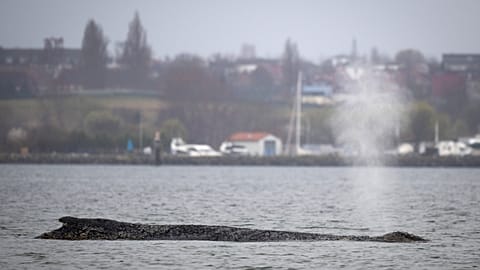
















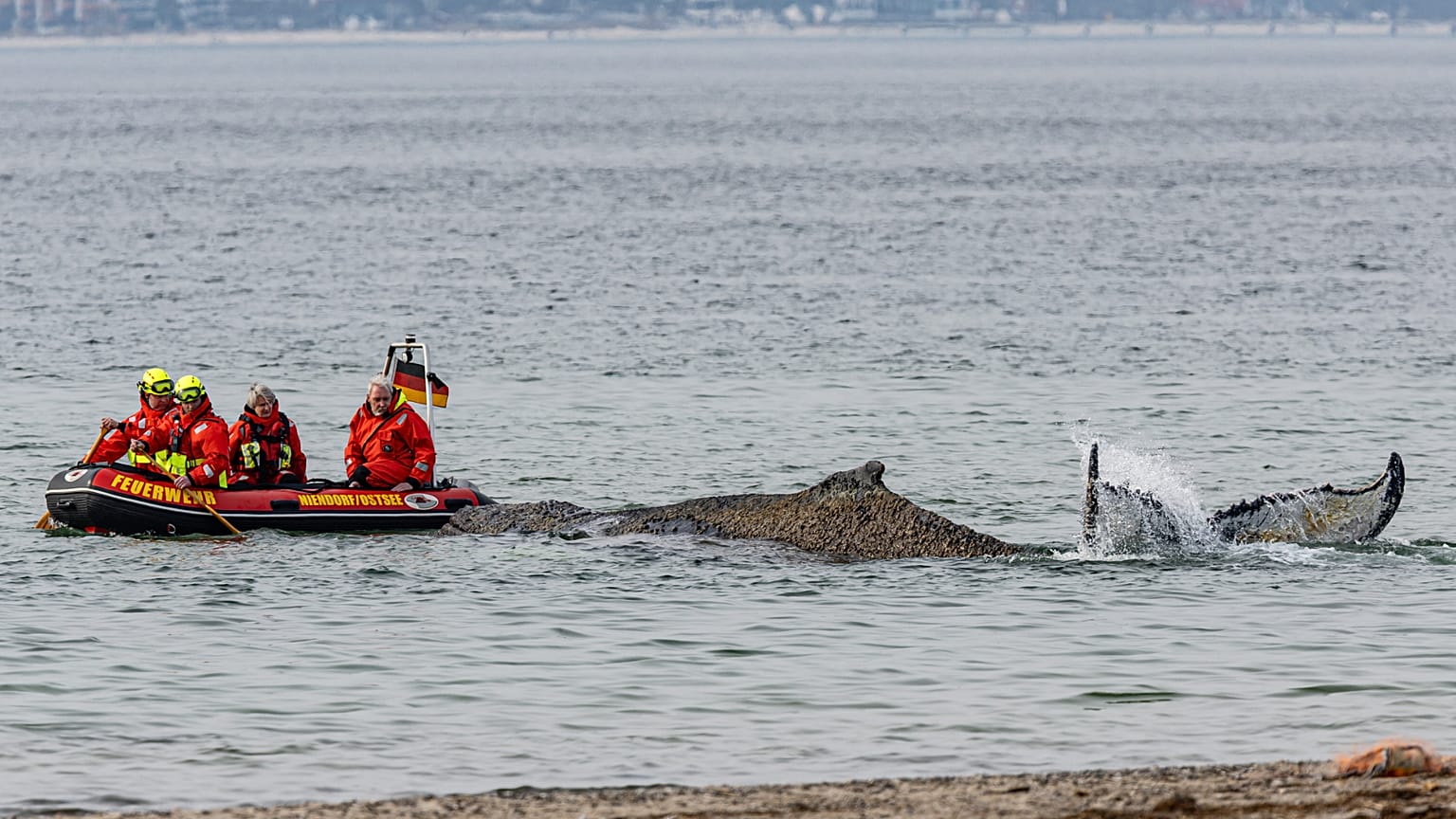














Police appealed to onlookers, who say they hear the whale's cries during the night, to keep their distance so "that the animal does not become even more stressed”.
A whale that was stranded for days in shallow water at a Baltic Sea resort in Germany has swum free from a sandbank overnight after a last-ditch rescue effort.
 ADVERTISEMENT
ADVERTISEMENT
ADVERTISEMENT
But it isn't out of danger yet. An excavator spent Thursday (26 March) digging an escape channel. The whale then swam through it overnight, marine biologist Robert Marc Lehmann said on Friday, as reported by German news agency dpa.
The 30-foot long mammal has been stranded in shallow water since Monday, with low tides, stormy weather and the animal's size hampering efforts to get the whale back into deep waters.
But he cautioned that it was only a small step in the right direction for the marine mammal, which is 12-15 metres long, and that it will only really be at home again if it reaches the Atlantic Ocean.
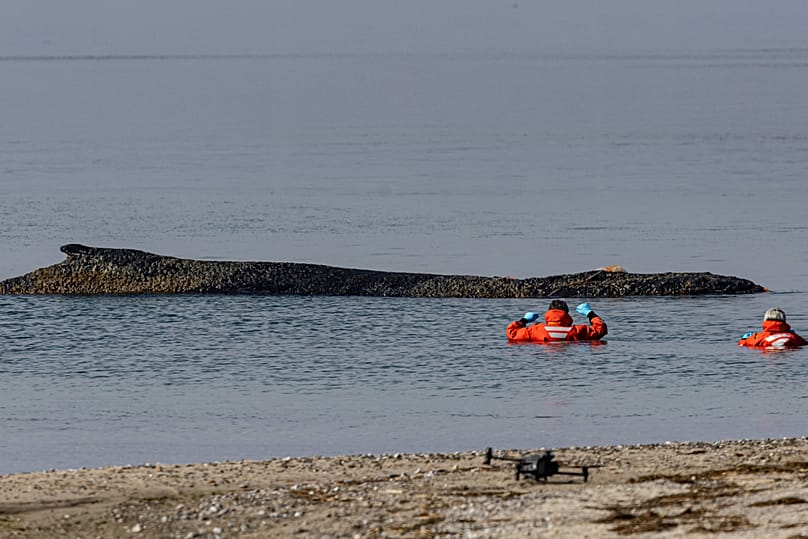
Rescue teams have been working around the clock
The whale was spotted stuck on an underwater sandbank in Timmendorfer Strand, a popular resort town, on Monday morning (21 March).
Many different techniques have been tried to move the animal, Initially boats were used to create waves around whale but they were not sufficient to shift him off the sand. Firefighter drones guiding the rescue efforts were also unsuccessful.
Next, rescuers tried to use a suction dredger but the sand beneath the animal could not be suctioned out because it was too compacted.
“If the whale can’t get off the beach, it’s a death sentence for the animal,” Sven Biertümpfel of Sea Shepherd told German public broadcaster NDR earlier this week, adding that the whale’s condition was deteriorating by the hour.
The animal, which weighs several tonnes, could not be pulled back into the sea because it could be seriously injured in the process, experts said. The Baltic Sea lacks strong tides that could have freed it.
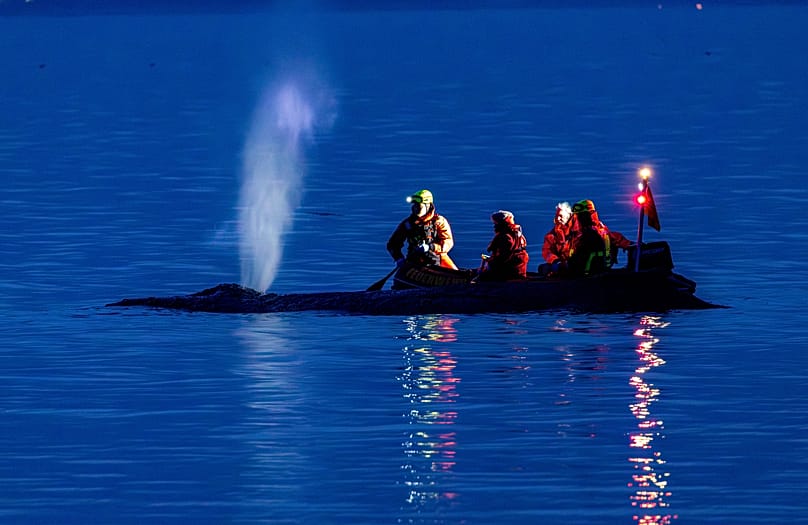
Drones and boats join fight to save stranded humpback whale in Germany
Many different techniques have been tried to move the animal, Initially boats were used to create waves around whale but they were not sufficient to shift him off the sand. Firefighter drones guiding the rescue efforts were also unsuccessful.
Next, rescuers tried to use a suction dredger but the sand beneath the animal could not be suctioned out because it was too compacted.
A larger excavator was brought in from Lower Saxony on Thursday to dig a trench in front of the whale's head, while Lehmann guided the digging.
Rescuers initially managed to turn the whale so its head was pointing toward deeper water, hoping it could find its own way back there, but the animal then turned back to its previous position.
They worked until well after sunset, but hadn't quite been able to get the whale out by the time they had to stop work for the night.
Early on Friday morning, the whale was on its way out of Lübeck Bay, where Timmendorfer Strand is located, said Stephanie Gross of the Institute of Terrestrial and Aquatic Wildlife Research. She said the massive mammal, which was about 300 metres off the coast, was being accompanied by a coast guard ship and several boats.
It was not immediately clear why the whale got stranded, but rescuers found parts of a fishing net wrapped around the body of the whale, which they managed to cut off.
Humpback whales aren't native to the Baltic. This one faces a journey of several hundred kilometres through German and Danish waters if it is to reach the North Sea.
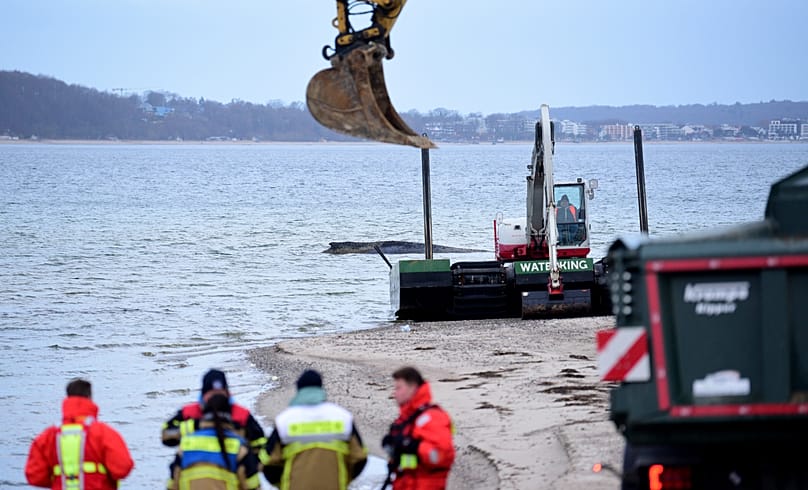
The young male has been spotted in the area before
Experts assume that the whale is a young male, as males, unlike females, tend to migrate. It also seems to be the same whale that has been spotted several times in the port of Wismar in eastern Germany in recent weeks.
Police have cordoned off the beach area with construction fences to keep a large crowd of onlookers at bay.
"It is very important that the animal does not become even more stressed,” police spokesperson Ulli Fritz Gerlach said.
Standing at a distance from the scene, strollers were out and about on the beach, moved by the struggle of the whale.
“Poor thing. I hope he can still be saved,” said Stefan Stauch, who had come with his wife from the nearby village of Scharbeutz. He said they had heard the whale's sounds during the night.
“We had hoped that the rising tide during the night would free him, but that didn’t work out.”