
















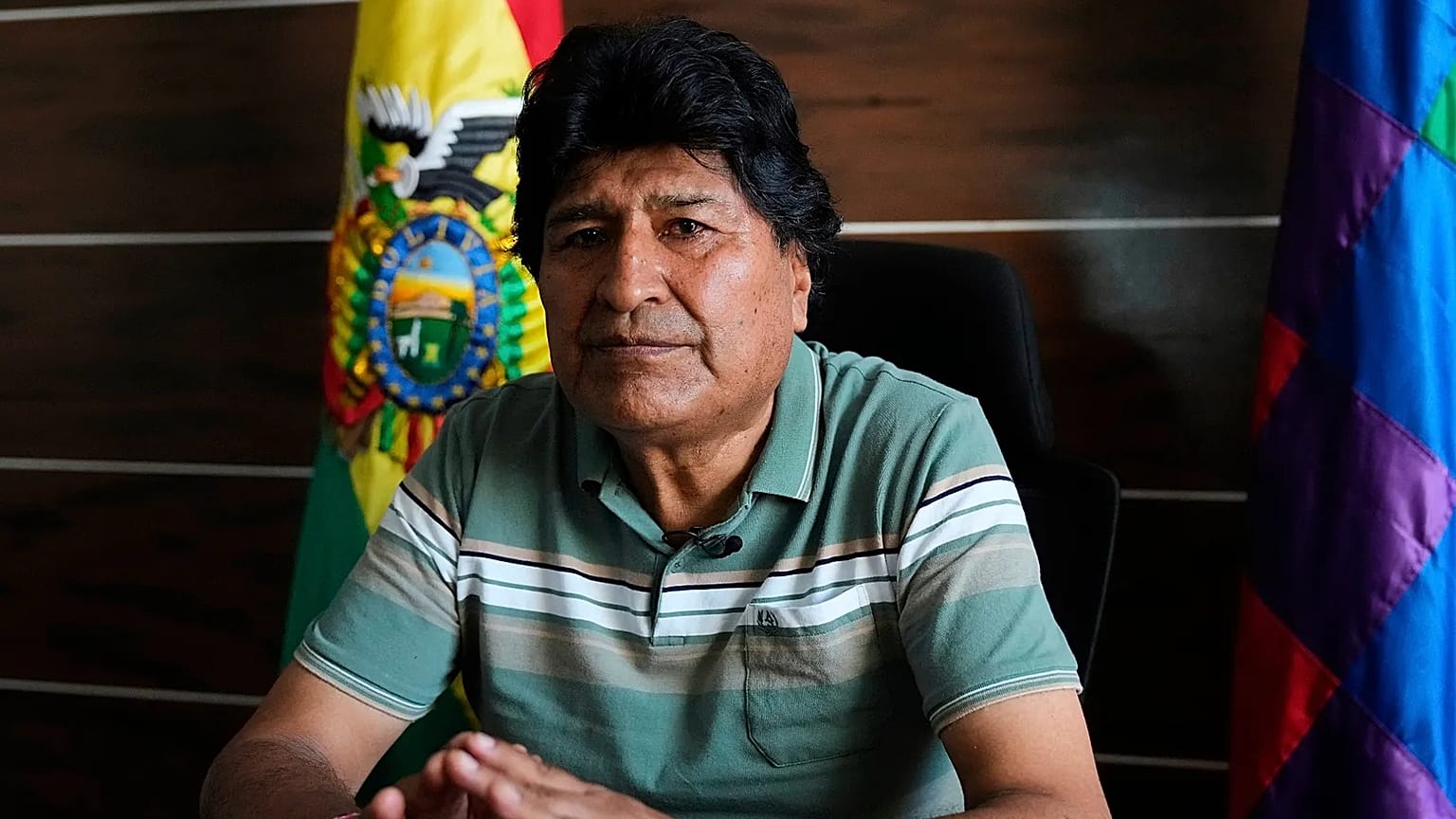













Evo Morales speaks out from hiding in the Chapare jungle as Bolivia enters its seventh week of fuel, food and medicine shortages.
To reach Evo Morales, you must pass through several checkpoints, push deep into the Chapare jungle and find Lauca Eñe — a remote village in his historic stronghold of Cochabamba, where the former Bolivian president has been in hiding for weeks.
 ADVERTISEMENT
ADVERTISEMENT
ADVERTISEMENT
An arrest warrant hangs over him. Dozens of supporters, some of them armed, stand guard around his hideout. The country is living through one of its most turbulent political periods in decades: a standoff pitting Morales and his followers against the government of President Rodrigo Paz, which has threatened to move in and detain him.
The former leader does not mince his words when asked whether he is considering turning himself in. "I am not going to surrender," he tells AFP, days after the government raised the possibility of sending forces into his stronghold to arrest him. "Anyone who negotiates over their own survival is not worthy," he adds.
Bolivia on the brink
The backdrop is a country teetering on the edge. For seven weeks, Bolivia's main cities have suffered shortages of food, fuel and medicine as roadblocks paralysed the centre-right government of Rodrigo Paz — whose resignation has been demanded by trade unions and Indigenous organisations alike.
Paz, who ended two decades of left-wing rule when he came to power in November, accuses Morales of instigating the protests. Last Saturday, he declared a state of emergency, deploying the army onto the streets.
For Morales, what is unfolding is nothing less than "an uprising against the neoliberal model and the colonial state" — one that has left, in his words, "a government without authority."
What happens if Morales is captured?
The question hanging over the entire conversation is what would happen if security forces moved into the Chapare. Morales dismisses such a scenario as unnecessary, arguing that the roadblocks have largely been lifted and no longer justify a deployment. But he does not conceal what he believes would follow if the government pressed ahead. "They are forcing a civil war," he warns. "Any military or police intervention will be resisted by the campesinos." He insists he does not want deaths or injuries — but adds: "We are well organised."
On the criminal case that drove him into hiding — an investigation into alleged child trafficking — Morales is unequivocal, dismissing it as "a fabricated case." "They cannot find anything on drug trafficking or corruption. Because Evo is not corrupt, they try to use the label 'paedophile'. People find it laughable," he says.
'At any moment, any sector will mobilise'
His outlook is bleak. Morales believes that without an economic recovery, the crisis will drag on indefinitely. He coins a pointed term for the current administration — a "mentirocracy," or rule by liars — which he says is provoking a fierce reaction among Bolivians.
"If the structural issue, which is the economic one, is not resolved, at any moment any sector will mobilise," he says.
Morales, who insists he has never explicitly called for the president's resignation, frames his demands in broader terms: blocking the privatisation of electricity, water, natural resources, healthcare and education. "That," he says, "is the demand."