

















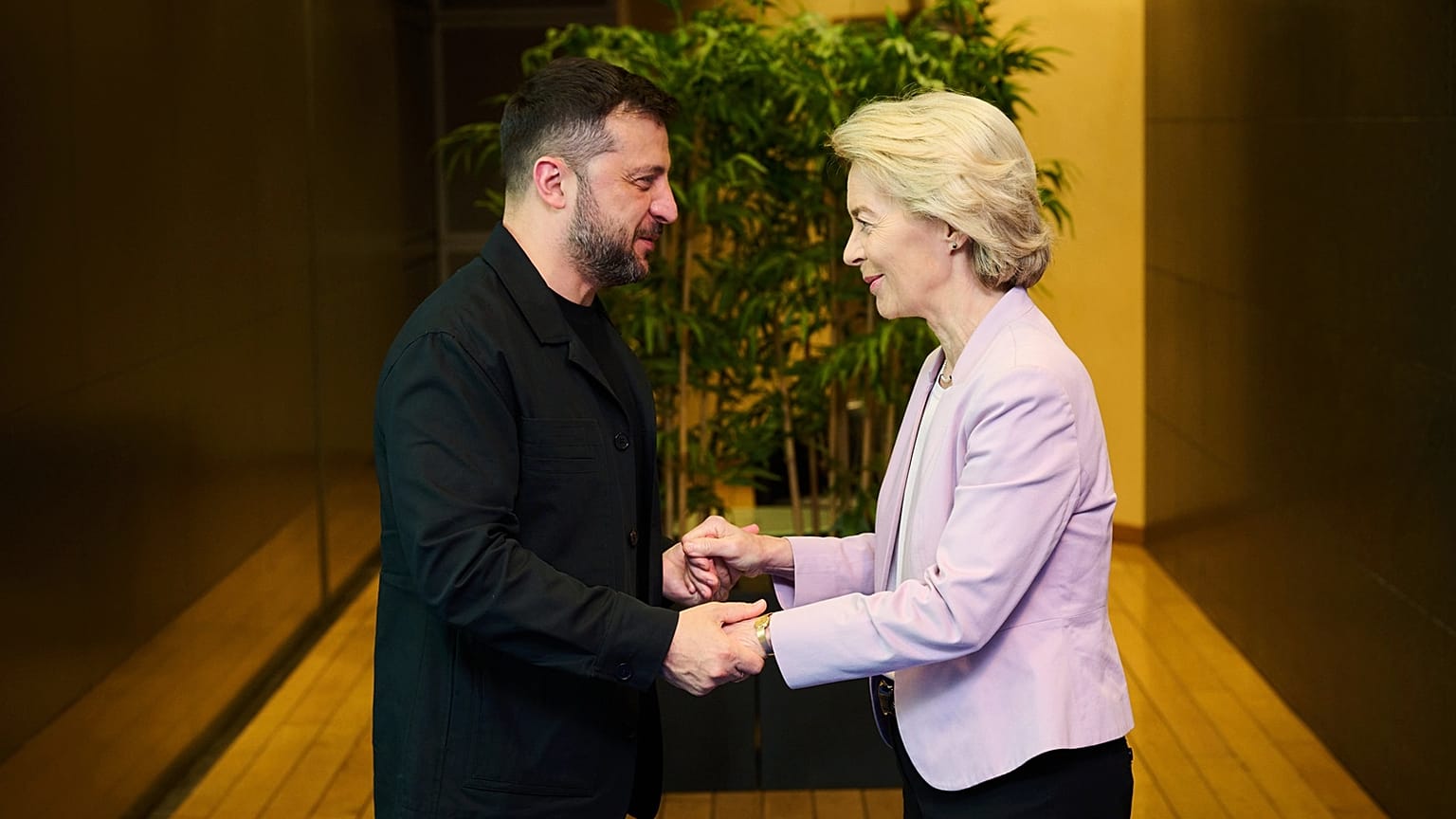














The announcement marks the first disbursement under the €90 billion loan. A second payment worth about €6 billion and dedicated to drone production is expected to be unveiled in the coming days.
Ukraine has received €3.2 billion as the first disbursement under the European Union's €90 billion support loan, Ursula von der Leyen has announced.
 ADVERTISEMENT
ADVERTISEMENT
ADVERTISEMENT
The €3.2 billion will help cover Kyiv's budgetary gaps and guarantee financial stability.
A second disbursement dedicated to drone production and worth about €6 billion is expected to be unveiled in the coming days.
The news comes as Ukraine enjoys renewed momentum on the battlefield against Russian troops and Moscow's war machine shows growing strain.
Today, we are transferring the first tranche under this loan, dear Yulia (Svyrydenko), it is exactly €3.2 billion in macro-financial assistance," the European Commission President said on Thursday while attending the Ukraine Recovery Conference in Gdańsk, Poland.
She was addressing Ukrainian Prime Minister Yulia Svyrydenko.
"This is indeed solidarity in action. It shows Europe’s support for Ukraine is here to stay," von der Leyen added.
The announcement marks a turning point in a six-month political struggle to get the loan off the ground.
The 27 EU leaders agreed on the extraordinary assistance package in December after an inventive proposal to tap into Russia's immobilised assets fell apart at the eleventh hour.
As an alternative, they chose to establish the €90 billion loan through joint debt. Hungary, Slovakia and the Czech Republic negotiated an exemption from the scheme.
Brussels sped up the technical and legal preparations to start disbursements as soon as possible and prevent the cash-strapped government in Kyiv from defaulting.
But in late February, just as Russia's full-scale invasion was about to turn four years old, Hungarian Prime Minister Viktor Orbán shocked his peers by imposing a sudden veto on the final legislative piece over an unrelated dispute with Ukraine involving the Druzhba oil pipeline.
The veto prompted an acrimonious exchange of recriminations between Budapest and Kyiv, with Brussels caught in the middle. The impasse was not resolved until late April, after Orbán had suffered a resounding defeat in Hungary's general election.
Now, six months after the crucial summit in December, the EU has reached a stage where it can finally start wiring the cash.
The €3.2 billion marks the start of a series of payments that will be made gradually through the end of the year. For 2026, Brussels has allocated €45 billion, with €16.7 billion for financial support and €28.3 billion for military support.
Payments will be made conditional on reforms in Kyiv, and any reversal in the fight against corruption could trigger a temporary suspension in assistance.
Notably, the military strand of the loan will come with strings attached to ensure it benefits "Made in Europe" weaponry and ammunition.
However, the next €6 billion disbursement will be exempted from this obligation because Ukraine needs to buy certain components from China to produce its low-cost drones.
Kyiv is also seeking ways to procure US-made Patriot air defence systems. It is unclear if the European loan would be used for this purpose at a later point.
"Ukraine has the opportunity to analyse the situation on the battlefield and identify the range of products that they need, and then they have to inform us in the form of product schedules," a Commission spokesperson said.
"The priority remains to make purchases within the EU and Ukraine."
The remaining €45 billion will be reserved for 2027 and cover two-thirds of Ukraine's funding needs. Western allies are meant to cover the other one-third.
The United States is not expected to contribute to the financial equation.
"We continue to call on all our partners to maintain their support, because a strong and independent Ukraine is in all our interests," von der Leyen said on Thursday.
"Our ambition is not only to help Ukraine endure, it is also to help Ukraine grow and prosper as a free and European country."
The 24 member states that participate in the common borrowing will pay an estimated €3 billion in annual interest rates.
Ukraine will only be asked to return the €90 billion loan if Russia ever agrees to war reparations, something that Moscow has categorically ruled out.
The Commission insists it retains the right to use the Russian Central Bank's €210 billion in immobilised assets in the absence of reparations.
This article has been updated.