





























The milestone comes after a busy testing period for NASA. Since the first flight on 28 October 2025, the team has completed 16 flights in the last 90 days
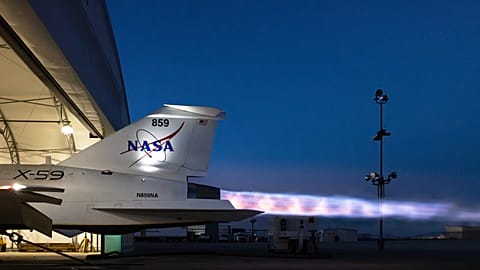
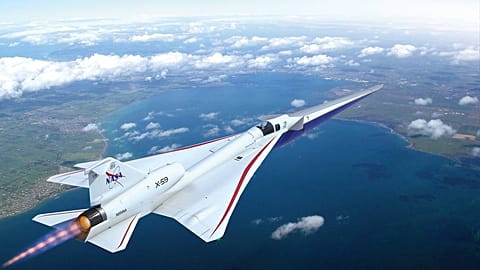
NASA’s experimental X-59 aircraft has flown faster than the speed of sound for the first time, marking a significant step in the development of quiet supersonic flight technology.
 ADVERTISEMENT
ADVERTISEMENT
ADVERTISEMENT
NASA test pilot Jim "Clue" Less took off and landed at Edwards Air Force Base in California, reaching a top speed of approximately Mach 1.1 (1,147 km/h) and an altitude of 13,228 metres.
The aeroplane’s flight began at 11:08 am local time (8:08 pm CEST) on Friday and lasted 81 minutes. The engineering team focused on flying qualities at both subsonic and then supersonic speeds.
The milestone comes after a busy testing period. Since the first flight on 28 October 2025, the team has completed 16 flights in the last 90 days.
NASA Administrator Jared Isaacman said, "I’m grateful to the NASA team and Lockheed Martin Skunk Works for their help getting us to this point, and I hope this is the first of many collaborations as we rebuild NASA’s X-plane portfolio.”
The X-59 is designed to fly at supersonic speeds while creating only a quiet thump instead of a loud sonic boom. For this flight, a NASA F-15 chase aeroplane flew nearby to monitor the X-59.
The loud sonic booms from the F-15 obscured any sound made by the X-59.
In just days, the aeroplane is expected to make its first 'mission conditions' flight. This test will see the aircraft reach a cruising speed of Mach 1.4 (1,489 km/h) and an altitude of approximately 16,764 metres.
The X-59 will also be accompanied by a chase aeroplane for this flight. These conditions will serve as the baseline when the aircraft eventually flies over several communities in the US. NASA’s experimental X-59 aircraft has flown faster than the speed of sound for the first time, marking a significant step in the agency's development of quiet supersonic flight technology.
NASA test pilot Jim "Clue" Less took off and landed at Edwards Air Force Base in California, reaching a top speed of approximately Mach 1.1 (1,147 km/h) and an altitude of 13,228 metres.
The aeroplane’s flight began at 11:08 am local time (8:08 pm CEST) on Friday and lasted 81 minutes. The engineering team focused on flying qualities at both subsonic and then supersonic speeds.
The milestone comes after a busy testing period. Since the first flight on 28 October 2025, the team has completed 16 flights in the last 90 days.
NASA Administrator Jared Isaacman said, "I’m grateful to the NASA team and Lockheed Martin Skunk Works for their help getting us to this point, and I hope this is the first of many collaborations as we rebuild NASA’s X-plane portfolio.”
The X-59 is designed to fly at supersonic speeds while creating only a quiet thump instead of a loud sonic boom. For this flight, a NASA F-15 chase aeroplane flew nearby to monitor the X-59.
The loud sonic booms from the F-15 obscured any sound made by the X-59.
In just days, the aeroplane is expected to make its first 'mission conditions' flight. This test will see the aircraft reach a cruising speed of Mach 1.4 (1,489 km/h) and an altitude of approximately 16,764 metres.
The X-59 will also be accompanied by a chase aeroplane for this flight. These conditions will serve as the baseline when the aircraft eventually flies over several communities in the US.
The flights will enable NASA to gather data about how people perceive the quiet thump, after which NASA will share its findings with US and international regulators to help establish new noise standards.
The flights will enable NASA to gather data about how people perceive the quiet thump, after which NASA will share its findings with US and international regulators to help establish new noise standards.