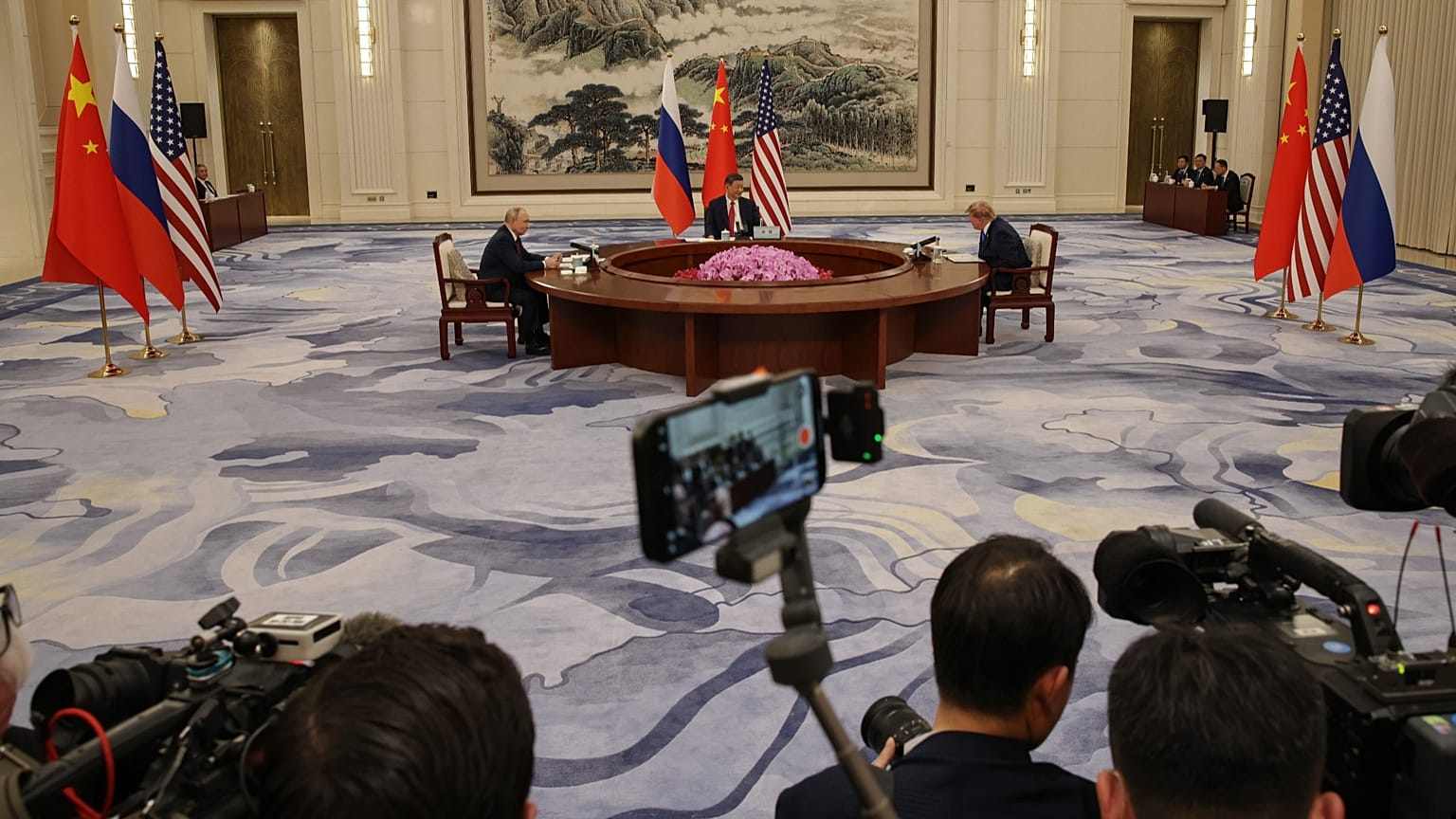


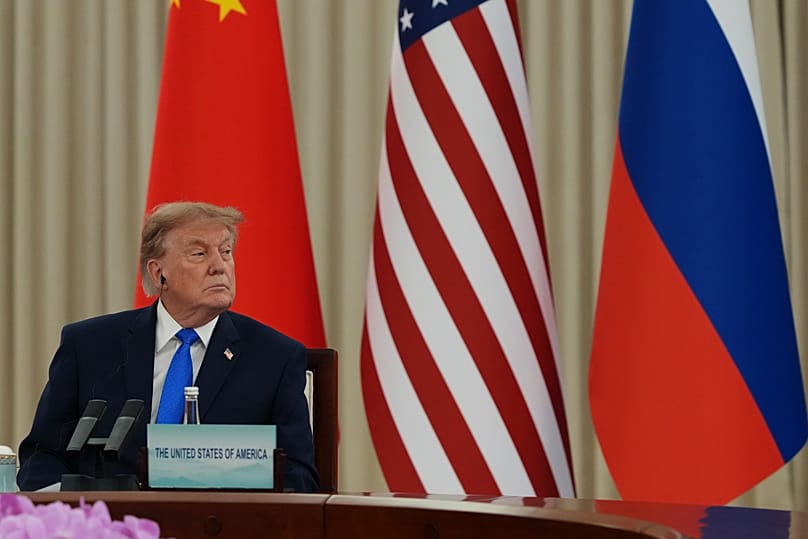
Trump declared that “we have great responsibilities to solve problems that affect the entire planet,” as he joined China's Xi and Russia’s Putin for the historic trilateral summit in China, while Xi said “the world is at peace when great powers live in harmony.” The meeting ended without statements.
The unprecedented trilateral meeting in Shenzhen between US President Donald Trump, China’s Xi Jinping and Russia’s Vladimir Putin ended on Thursday without statements from the three leaders, after Trump declared at the beginning that the three global powers "are making history".
 ADVERTISEMENT
Opening their first such summit, which could be a pivotal moment in world history, Trump said the three leaders “will talk about all problems that are being discussed in the world.”
“We have great responsibilities to solve problems that affect the entire planet," he added.
Trump said he had a "long discussion" with Putin on Russia's ongoing all-out war in Ukraine and that all sides "would like to see an end to that war".
Xi joined Trump in saying their summit “has groundbreaking significance”, adding that “the world is at peace when great powers live in harmony," calling on the three countries to “abandon Cold War mentality, not pursue decoupling and breaking chains”.
"The three countries should work together to address global challenges,” and that they "can strengthen coordination to safeguard global energy supply chain stability," Xi said. “Adversity reveals true responsibility.”
Putin said that Russia’s war in Ukraine would be part of the talks, stating that “we have shared interests in Ukraine.”
“Russia, the US and China are united not only by their status as victorious nations in World War II, but also by their responsibility for maintaining international peace,” Putin said.
However, after the summit ended, Kremlin spokesman Dmitry Peskov told the Russian media that Ukraine was not "the central topic" at the summit.
Just as the summit was starting, China's state news agency published a statement from Xi saying that “nuclear weapons should be comprehensively banned and thoroughly destroyed, building a nuclear-free world.”
In his opening statements, Trump said that the “three countries are uniquely positioned to discuss nuclear weapons."
“Too often past leaders avoided talking to leaders they had disagreements with,” Trump added.
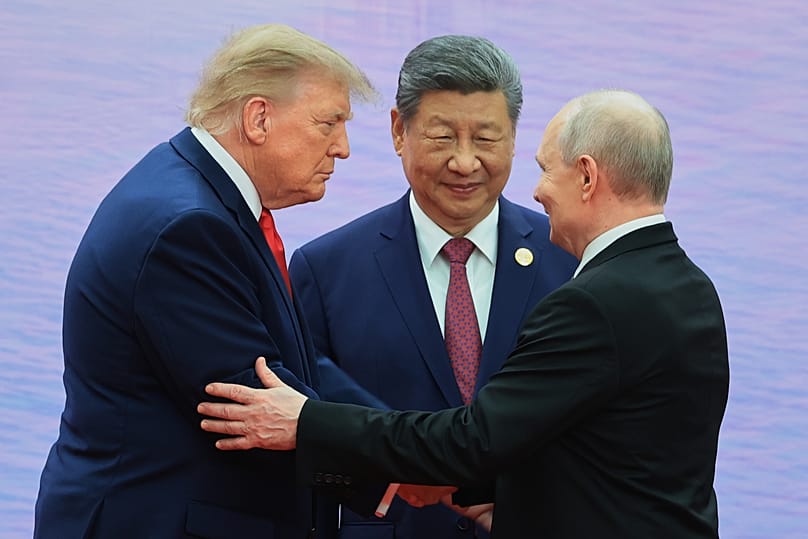
The leaders posed for a family photo without shaking hands as they started their summit and made no statements when it concluded.
The meeting ended after around an hour and 20 minutes. Trump left the venue immediately for Shenzhen's airport and took off shortly after, while Xi accompanied Putin who also departed for Russia.
China's state news agency Xinhua published the full text of what it called the "trilateral peace declaration," listing four key points: commitment to UN reform, plans to increase the production and supply of refined petroleum products, respect for the immunity of state officials and opposition to the ICC and similar institutions abusing their jurisdiction, as well as an agreement to hold dialogue on nuclear risk reduction and non-proliferation.
The declaration makes no explicit reference to Ukraine, Iran, Taiwan or North Korea.
High-stakes bilateral talks before the trilateral
The US and Chinese presidents met bilaterally earlier on Thursday in their third substantial meeting this year.
During the meeting, Trump said that the US and China want to help end the war in Ukraine, stating that "we're looking to both help with respect to the war with Russia and Ukraine."
The US president praised their friendship and their shared interest in having oil shipped through the Strait of Hormuz, which has become a key site of attacks in the Iran war.
Xi said that relations between the US and China have been “generally stable and improved” during Trump’s presidency.
“The efforts you have made are there for all to see and will go down in history,” Xi said.
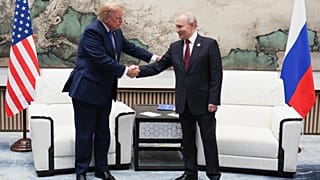
Trump also met Putin ahead of the trilateral, stating that “we’ve had a great relationship for many years.”
Their meeting marks the first time the leaders have held talks since their discussions in Alaska last year that failed to broker a deal to ease Russia's all-out war in Ukraine.
“Wonderful things can come out of this, or at least start,” Trump said as he greeted Putin, saying "Who is he? He's my friend."
The summit has stoked fears that the three powerful men may seek to divide the globe into spheres of influence, for example by making decisions that affect Ukraine's fate over the heads of Kyiv or Europe.
A wider debate raged among observers on social media over whether the summit can be dubbed a "Yalta 2.0," while others claim it should instead be dubbed Munich 1938, given the fundamental differences in time, space and the protagonists.
To underline the summit's weight and balance European and wider Western media coverage, Asian television stations and newspapers focused on the possible consequences for their own countries.
Chinese state media, particularly Xinhua and People's Daily, framed the APEC summit and the trilateral around Xi's diplomatic leadership, multilateral cooperation and China's commitment to free trade. Beijing is presenting the trilateral summit as an opportunity to promote global peace and strategic stability among major powers.
In South Korean media, a recurring theme was concern over a potential “Yalta 2.0” conference, in which leaders could discuss the future of the Korean peninsula without Seoul's participation, with news agency Yonhap reporting that the South Korean government has conveyed these concerns to both Washington and Beijing.
The coverage is also focusing on the possibility of renewed US–North Korea dialogue and the risk of tacit acceptance of North Korea's nuclear status.
Japanese media are focusing on strained Sino-Japanese relations, with one major TV channel reporting on the first face-to-face encounter between Japanese Prime Minister Sanae Takaichi and Xi in about a year.
No formal bilateral meeting between Takaichi and Xi has been scheduled, and the Japanese media reported that Takaichi was seeking a discussion with Trump following the trilateral summit.
Germany was also due to host Ukraine's allies for a "Coalition of the Willing" meeting on Thursday involving US envoys Jared Kushner and Steve Witkoff.